
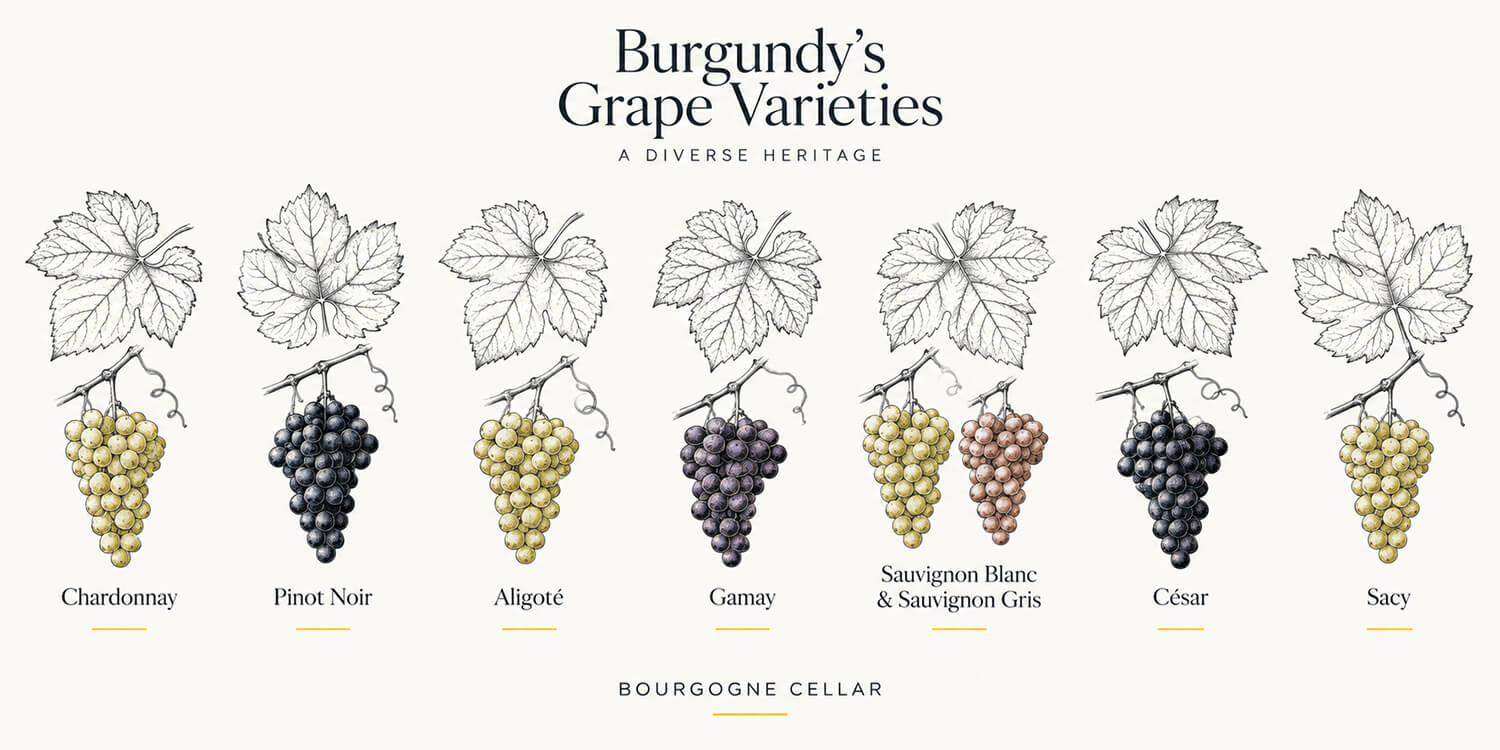
César is one of Bourgogne’s great curiosities. While Pinot Noir dominates the region’s red wines, this ancient dark-skinned grape survives in a very small corner of northern Bourgogne. Its stronghold is Irancy, in the Grand Auxerrois, southwest of Chablis. Here, César can be blended with Pinot Noir, adding colour, tannin and structure to wines that otherwise remain unmistakably Burgundian. For wine lovers interested in Bourgogne beyond its famous grape varieties, César offers a fascinating glimpse into the region’s viticultural past.
An ancient grape
César has been cultivated around Auxerre for centuries. The variety is sometimes locally known as Romain, a name connected to the traditional story that Roman soldiers introduced it to the area. It is a wonderful story, although its Roman origin should not be taken too literally. Modern genetic research has shown César to be a natural crossing between Pinot and Argant, placing it firmly within the complex family history of old French grape varieties. Whatever its precise origins, César has a long-established home in the vineyards around Irancy.
César and Irancy
César’s modern importance in Bourgogne is almost entirely connected to Irancy AOC. Irancy is principally a Pinot Noir wine, but appellation rules allow a limited proportion of César. Not every producer uses it: some make their Irancy entirely from Pinot Noir, while others value César as part of the traditional identity of the area. It is therefore important not to think of Irancy as a César wine. Rather, César is a supporting variety capable of changing the character of the blend.
What does César taste like?
Compared with Pinot Noir, César is generally deeper in colour and considerably more tannic. It can contribute dark fruit, spice, structure and firmness, particularly when young. Even a relatively small addition can give an Irancy more backbone and potentially increase its capacity to age. This creates an interesting contrast with Pinot Noir, whose perfume, red fruit and finesse remain central to the wine. César on its own can sometimes feel rather rustic. In a carefully judged blend, however, that strength becomes useful. Pinot Noir provides elegance and aromatic complexity; César can add grip and depth.
César in the vineyard
César is vigorous and can produce relatively large yields if not carefully controlled. Achieving good ripeness is particularly important because insufficiently ripe grapes can result in rather hard tannins. This matters in the cool northern vineyards of the Grand Auxerrois. Site selection, yield management and harvest timing all influence whether César contributes attractive structure or simply excessive firmness. Modern growers therefore tend to use the variety thoughtfully rather than automatically.
A survivor from another Bourgogne
César will never challenge Pinot Noir, Chardonnay or even Aligoté in terms of vineyard area. Its importance is cultural rather than quantitative. The grape survives because it belongs to a particular place and tradition. In Irancy, it gives producers an option that exists almost nowhere else in Bourgogne. That makes César worth knowing. It is a small surviving piece of Bourgogne’s history — and one that you can still taste in the glass today.