Chardonnay is grown around the world, from cool European vineyards to warm regions in Australia, California and South Africa. Yet for many wine lovers, Bourgogne remains the reference point for Chardonnay.
What makes Bourgogne particularly fascinating is the diversity. The same grape can produce the steely freshness of Chablis, the generous texture associated with Meursault and the extraordinary refinement of the great vineyards around Puligny-Montrachet. Further south, the Mâconnais shows yet another, often riper and more generous expression. Chardonnay in Bourgogne is therefore less about a single flavour profile and more about how one grape responds to different places.
An old Bourgogne variety
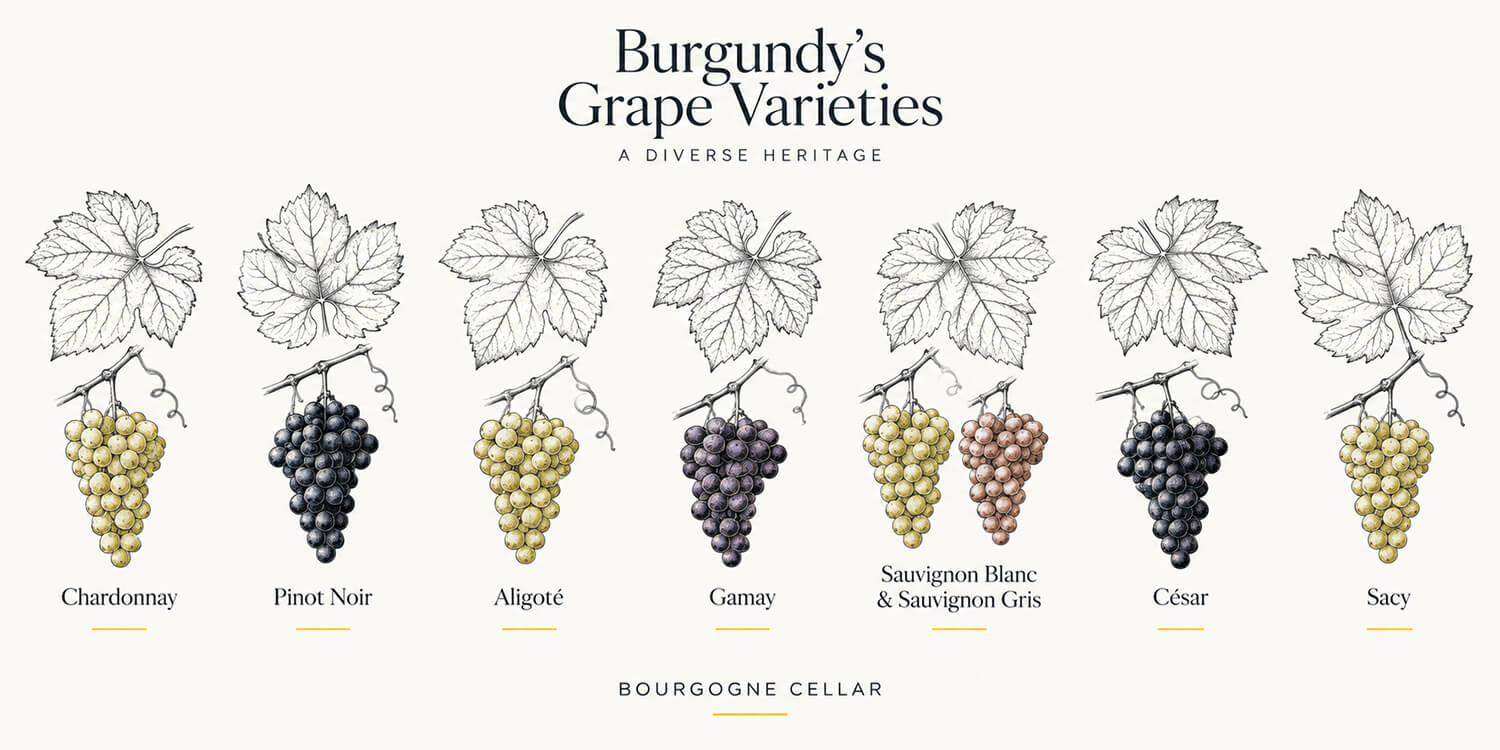
Chardonnay has deep historical roots in Bourgogne. DNA research has shown it to be a natural crossing between Pinot and Gouais Blanc, and the variety has been cultivated in the region for centuries. Today it is Bourgogne’s dominant white grape and is permitted or required in numerous AOCs. In many famous white-wine appellations, Chardonnay is essentially the defining variety.
Interestingly, the grape itself is rarely the most prominent information on a traditional Bourgogne label. The appellation and vineyard take precedence. A bottle from Chablis, Meursault or Puligny-Montrachet may not need to announce Chardonnay prominently because its origin already tells an informed drinker what is inside.
What does Bourgogne Chardonnay taste like?
There is no single answer. In cooler Chablis, Chardonnay can be lean, citrus-driven and intensely fresh, frequently showing green apple, lemon and saline or chalky impressions. In the Côte de Beaune, the spectrum becomes broader. Wines can show pear, citrus, white flowers and stone fruit, developing notes of hazelnut, butter, toast and honey with winemaking and bottle age. The finest examples combine richness with acidity and tension rather than simply being powerful. Further south in the Côte Chalonnaise and Mâconnais, warmer conditions can produce more generous Chardonnay, with ripe orchard and stone-fruit flavours while good sites retain freshness.
Chardonnay in the vineyard
Chardonnay buds relatively early, making spring frost an important risk, particularly in northern Bourgogne. Growers must also manage yields and canopy carefully to achieve healthy grapes with sufficient concentration while preserving acidity.
Harvest timing is crucial. Pick too early and the wine can lack flavour and depth; too late and freshness can disappear quickly. This balance has become increasingly important as Bourgogne experiences warmer growing seasons. Vineyard work therefore plays a major role in determining whether Chardonnay expresses richness, freshness or — ideally — both.
In the cellar
Chardonnay is remarkably receptive to winemaking choices. Some Bourgogne is fermented and matured primarily in stainless steel, preserving freshness and purity. Elsewhere, traditional oak barrels are important. Producers can vary the proportion of new oak, barrel size, time on the lees and frequency of bâtonnage. Malolactic fermentation is common and can soften acidity while contributing additional texture. But great white Bourgogne is rarely simply about tasting oak or butter. The most accomplished producers use these techniques to support the wine rather than obscure its origin.
A grape that lets Bourgogne speak
Perhaps Chardonnay’s greatest strength is that it does not need to dominate the wine. It can be fresh or rich, restrained or powerful, approachable young or capable of ageing for decades. Yet in Bourgogne, the most interesting question is usually not simply “What does Chardonnay taste like?” It is “What does Chardonnay taste like from this particular place?” That question takes you to the heart of white Bourgogne.