The cork may seem like a small detail, but for wines intended to age for years or even decades, the choice of closure matters. It influences how much oxygen enters the bottle, how consistently bottles develop and, in the case of traditional cork, whether there is a risk of cork taint. In Bourgogne, natural cork remains important, particularly for prestigious and age-worthy wines. At the same time, technological corks such as DIAM have become increasingly common.
Natural cork
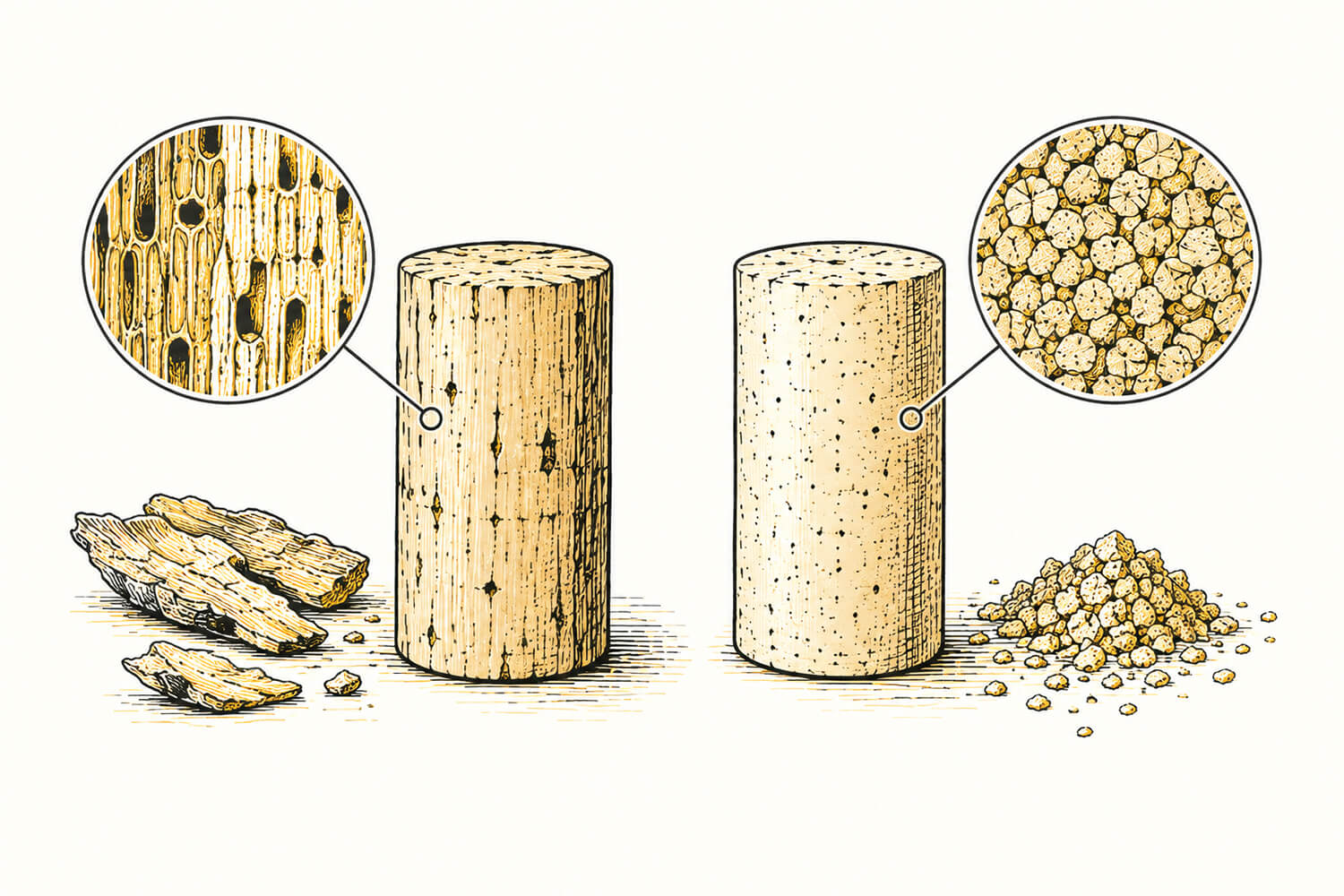
Traditional wine corks are cut from the bark of the cork oak (Quercus suber), predominantly grown around the western Mediterranean. Natural cork combines elasticity with a very low permeability to oxygen, making it particularly suitable for long-term bottle ageing. However, natural cork is not perfectly uniform. Individual corks can differ slightly in structure and permeability, meaning two bottles of the same wine may develop differently over time. There is also the possibility of contamination by TCA (2,4,6-trichloroanisole), the compound most commonly associated with what we call a “corked” wine. For many Bourgogne producers and collectors, natural cork nevertheless remains the traditional choice, especially for wines expected to spend many years in the cellar.
DIAM corks
DIAM is also made from cork, but in a very different way. Cork granules are treated using the company’s DIAMANT process with supercritical CO₂ to remove compounds capable of causing sensory deviations. The purified cork material is subsequently formed into closures with highly consistent physical properties. DIAM guarantees releasable TCA below its quantification limit. An important advantage is control over oxygen transmission. DIAM closures are available with different permeability levels, allowing a producer to choose how much oxygen is transferred through the closure during bottle ageing. Depending on the model, DIAM specifies oxygen transfer rates of approximately 0.3 to 0.6 mg per year.
The numbers in names such as DIAM 5, DIAM 10 and DIAM 30 primarily refer to the closure’s mechanical guarantee: five, ten or thirty years. They should therefore not be interpreted simply as different levels of oxygen permeability. Within the range, different permeability options can be available. There is also Origine by DIAM, a bio-sourced version incorporating a beeswax emulsion and a binder based on plant-derived polyols. The range currently includes Origine 3, 5, 10 and 30.
What is used in Bourgogne?
There is no single standard closure in Bourgogne. Natural cork remains widely associated with the region, but DIAM has gained a substantial following, including among producers of serious, cellar-worthy wines. Reported users have included domaines such as Comtes Lafon, de Montille, Méo-Camuzet and Taupenot-Merme, while other producers continue to favour natural cork.
The choice is ultimately part of the winemaker’s approach to élevage and ageing. Natural cork offers tradition and the characteristics of an individual natural material. DIAM offers considerably greater consistency between bottles, protection against cork taint and more precise control over oxygen transmission. For collectors, the closure is therefore worth noticing. It is not simply the final step in packaging a Bourgogne: it can influence how reliably that bottle develops in the cellar.