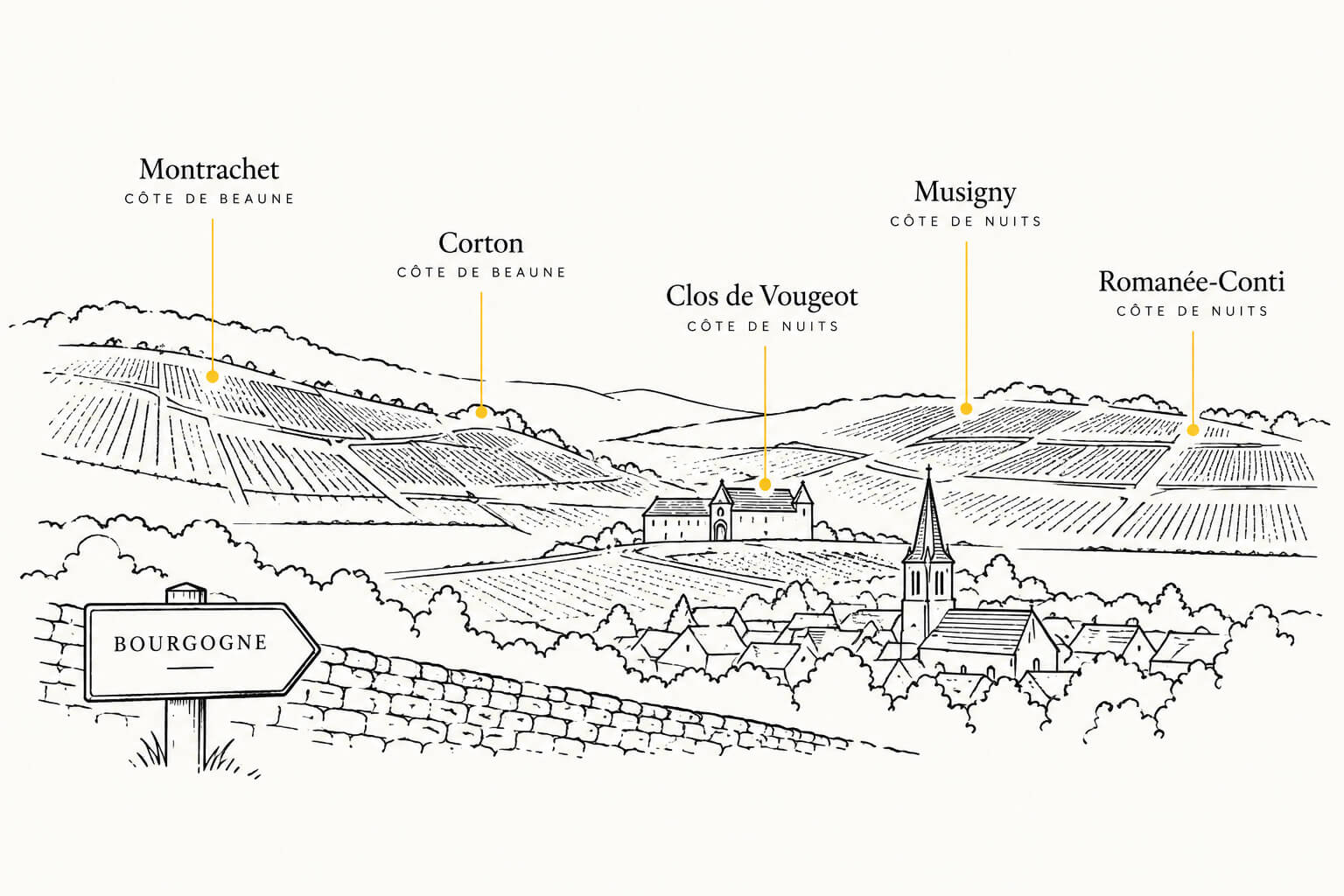
At the very top of Bourgogne’s vineyard hierarchy are its Grand Crus. These are not simply expensive wines or the best wines of individual producers. Grand Cru is attached to specific, precisely delimited vineyards that have acquired an exceptional reputation over centuries. They form a remarkably small part of Bourgogne. Some cover dozens of hectares, while the smallest barely reaches a single hectare. Names such as Montrachet, Chambertin, Musigny and Romanée-Conti have become synonymous with some of the world’s most sought-after wines.
Most of Bourgogne’s Grand Crus are concentrated in the Côte de Nuits, particularly around Gevrey-Chambertin, Morey-Saint-Denis, Chambolle-Musigny, Vougeot, Vosne-Romanée and Flagey-Échezeaux. The Côte de Beaune has fewer Grand Crus, but includes the great Chardonnay vineyards of Montrachet and Corton-Charlemagne. Further north, Chablis has its own distinctive Grand Cru.
Grand Crus of Chablis
Chablis · approximately 100 ha · Chardonnay
Chablis is the exception to the pattern found further south. Rather than several separate Grand Cru appellations, Chablis Grand Cru is a single appellation situated on the slopes overlooking the town of Chablis. Within it are seven officially recognised climats: Blanchot, Bougros, Grenouilles, Les Clos, Les Preuses, Valmur and Vaudésir. Their individual names commonly appear on labels. Despite their proximity, differences in exposure, gradient and soil give each climat its own character. Chablis Grand Cru generally represents the most concentrated, structured and age-worthy expression of Chardonnay in the region.
Grand Crus of the Côte de Nuits
The Côte de Nuits contains the greatest concentration of Grand Cru vineyards in Bourgogne. With very few exceptions, these vineyards are devoted to Pinot Noir.
Gevrey-Chambertin
No village has more individual Grand Cru appellations than Gevrey-Chambertin and its immediate surroundings.
Chambertin — approximately 13 ha
One of the historic giants of Bourgogne. Chambertin is associated with powerful, structured Pinot Noir capable of developing for decades.
Chambertin-Clos de Bèze — approximately 15 ha
Immediately adjacent to Chambertin and similarly prestigious. Clos de Bèze can combine considerable intensity with perfume and finesse.
Chapelle-Chambertin — approximately 5.5 ha
A relatively small Grand Cru, generally producing refined and aromatic expressions of Gevrey-Chambertin.
Charmes-Chambertin — approximately 28 ha
One of the larger Grand Crus of Gevrey. The wines are often associated with generosity, perfume and a comparatively supple character.
Griotte-Chambertin — approximately 2.5 ha
Tiny even by Bourgogne standards. Its scarcity contributes to its status as one of the harder Gevrey Grand Crus to encounter.
Latricières-Chambertin — approximately 7 ha
Situated close to Chambertin itself. Often characterised by a cooler, more mineral and restrained expression.
Mazis-Chambertin — approximately 8.5 ha
A powerful Grand Cru at the northern end of the Grand Cru slope, capable of producing deeply structured and long-lived wines.
Mazoyères-Chambertin — approximately 3 ha
Closely connected with Charmes-Chambertin. Wines from Mazoyères may legally be sold as Charmes-Chambertin, which means the name Mazoyères-Chambertin is seen relatively infrequently on labels.
Ruchottes-Chambertin — approximately 3 ha
Another of Gevrey’s smallest Grand Crus, situated high on the slope and known for wines that can combine delicacy with considerable depth.
Morey-Saint-Denis
Morey-Saint-Denis is remarkable for the concentration of Grand Cru vineyards around such a small village.
Clos de la Roche — approximately 17 ha
The largest Grand Cru of Morey-Saint-Denis. Typically structured and deep, with the ability to age for many years.
Clos Saint-Denis — approximately 6.5 ha
Generally finer and more perfumed in expression than Clos de la Roche, while retaining the depth expected of a Grand Cru.
Clos des Lambrays — approximately 8.5 ha
An almost-monopole historically associated with Domaine des Lambrays. The vineyard occupies a long section of the slope above Morey-Saint-Denis.
Clos de Tart — approximately 7 ha
One of Bourgogne’s famous monopoles: the entire Grand Cru is owned by a single estate. Its enclosed vineyard has remained intact for centuries.
Chambolle-Musigny
Bonnes-Mares — approximately 15 ha
Straddling Chambolle-Musigny and Morey-Saint-Denis, Bonnes-Mares often produces a more muscular expression of Pinot Noir than one might expect from Chambolle.
Musigny — approximately 10 ha
One of Bourgogne’s most revered vineyards. Musigny is celebrated for combining extraordinary perfume and finesse with depth and longevity. It is also unusual among Côte de Nuits Grand Crus because a very small quantity of white Musigny can be produced.
Vougeot
Clos de Vougeot — approximately 49 ha
One of the largest and most historically important Grand Crus. The famous walled vineyard contains many individual parcels and numerous owners, making the identity of the producer particularly important when choosing a bottle.
Flagey-Échezeaux
Échezeaux — approximately 36 ha
A large and complex Grand Cru divided into numerous lieux-dits. Style can vary considerably depending on parcel and producer.
Grands Échezeaux — approximately 8 ha
Much smaller than Échezeaux and situated alongside Clos de Vougeot. Generally associated with greater concentration, structure and consistency.
Vosne-Romanée
Few places in the wine world contain as much famous vineyard land in such a small area as Vosne-Romanée.
La Grande Rue — approximately 1.5 ha
A narrow Grand Cru situated between La Tâche and Romanée-Conti/Romanée-Saint-Vivant. It is a monopole of Domaine François Lamarche.
La Romanée — approximately 0.8 ha
The smallest Grand Cru appellation in Bourgogne and one of the smallest appellations in France. Its minuscule size makes production exceptionally limited.
La Tâche — approximately 6 ha
A monopole of Domaine de la Romanée-Conti and one of the most coveted Pinot Noir vineyards in the world.
Richebourg — approximately 8 ha
Known for exceptionally concentrated, powerful and complex Pinot Noir. Richebourg is divided among several owners, including some of the most celebrated domaines of Vosne-Romanée.
Romanée-Conti — approximately 2 ha
Perhaps the most famous vineyard in the world. Romanée-Conti is a monopole of Domaine de la Romanée-Conti and produces only a few thousand bottles in a typical vintage.
Romanée-Saint-Vivant — approximately 8.5 ha
Situated directly below Romanée-Conti. It is often associated with an exceptionally perfumed, silky and refined expression of Vosne-Romanée.
Grand Crus of the Côte de Beaune
The Côte de Beaune is particularly important for Grand Cru Chardonnay. Here we find the Montrachet family of vineyards and the large Grand Cru hill of Corton.
Corton
Corton — approximately 95 ha
Corton is unusual in both its size and complexity. The Grand Cru stretches across the hill shared by Aloxe-Corton, Pernand-Vergelesses and Ladoix-Serrigny and contains numerous named climats. It is best known for red Pinot Noir, although certain sections can also produce white Corton.
Corton-Charlemagne — approximately 58 ha
One of the great white wine appellations of Bourgogne. Chardonnay grown high on the Hill of Corton can produce powerful, mineral and exceptionally long-lived wines.
The Montrachet Grand Crus
The Grand Cru vineyards around Puligny-Montrachet and Chassagne-Montrachet form one of the most celebrated concentrations of Chardonnay vineyards anywhere in the world.
Montrachet — approximately 8 ha
The centrepiece of the group and arguably the world’s most famous Chardonnay vineyard. Montrachet straddles Puligny-Montrachet and Chassagne-Montrachet and is renowned for combining extraordinary richness, complexity and longevity.
Bâtard-Montrachet — approximately 12 ha
Situated immediately below Montrachet. Typically broad, powerful and concentrated, producing some of the richest dry Chardonnay in Bourgogne.
Bienvenues-Bâtard-Montrachet — approximately 3.5 ha
A small Grand Cru on the Puligny side, adjoining Bâtard-Montrachet. Often associated with a somewhat finer and more aromatic expression.
Chevalier-Montrachet — approximately 7.5 ha
Situated above Montrachet on the slope. Its wines are often described as more precise, mineral and restrained than those of Bâtard-Montrachet, while possessing exceptional ageing potential.
Criots-Bâtard-Montrachet — approximately 1.5 ha
The smallest of the Montrachet Grand Crus, situated entirely within Chassagne-Montrachet. Production is tiny and bottles are consequently rarely encountered.
A tiny part of Bourgogne
What makes the Grand Crus particularly remarkable is their scale. Bourgogne’s reputation extends around the world, yet its most prestigious vineyards occupy only a minute amount of land. And even within a Grand Cru, the name on the label tells only part of the story. Different parcels can have different exposures, elevations and soils, while choices in viticulture and winemaking remain crucial. A Grand Cru therefore does not guarantee that every bottle will be equal.
That is precisely what makes Bourgogne so fascinating. At its highest level, understanding a wine means looking beyond the classification: the vineyard, the exact parcel, the vintage and, above all, the producer all matter.