A Bourgogne wine label can be confusing at first. Producer, village, vineyard, classification and vintage may all appear prominently, while the grape variety you are looking for is sometimes nowhere to be seen. Fortunately, once you know what to look for, most labels become surprisingly informative.
Start with the producer
The producer’s name is one of the most important pieces of information on the bottle. You will often see Domaine before the name. This traditionally indicates an estate producing wine from vineyards it owns or farms. Maison is commonly associated with a négociant business, which may also purchase grapes or wine from other growers. Today, many Bourgogne producers combine both activities, so the distinction is not always absolute.
Find the geographical name
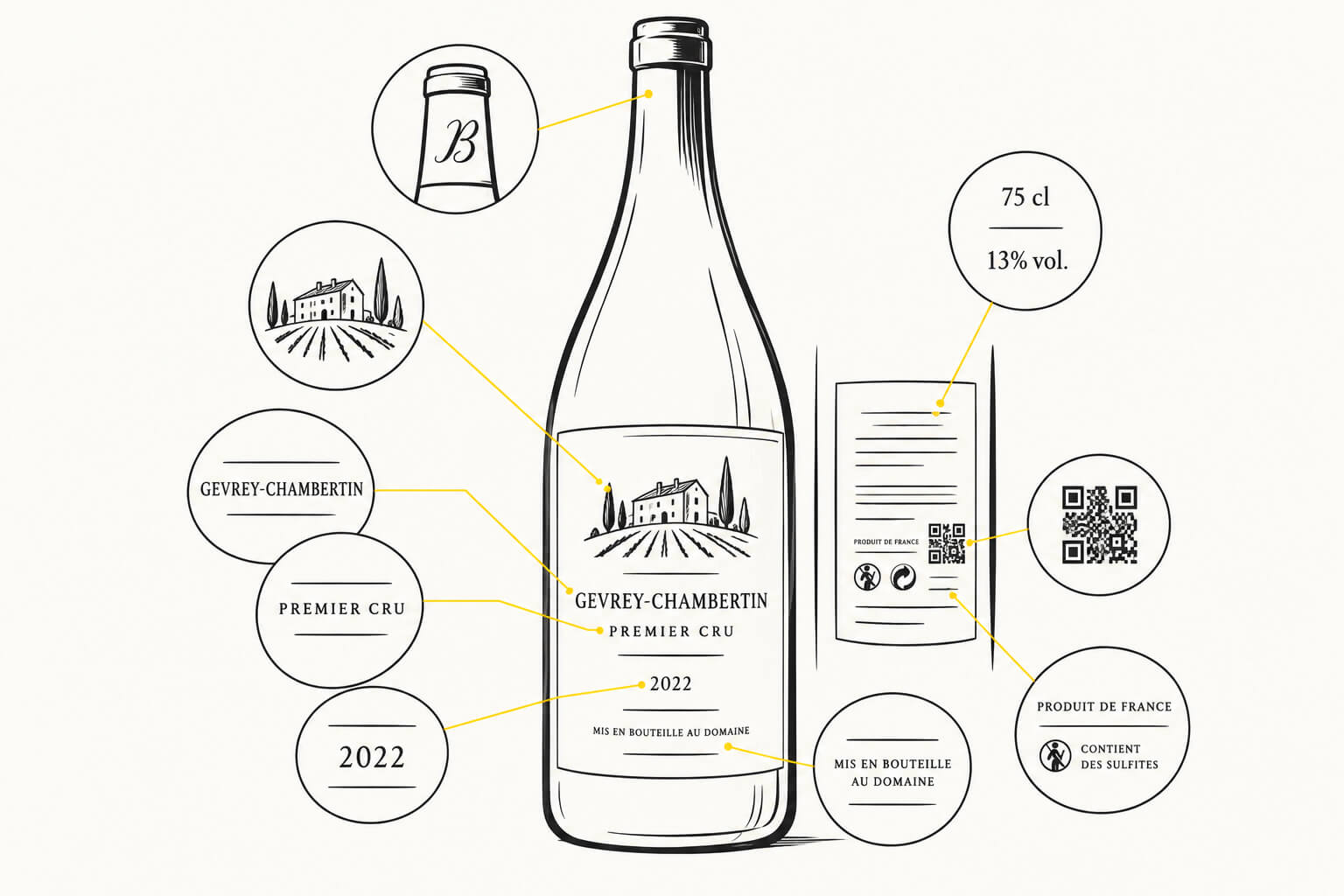
Next, look for the most prominent geographical name. Depending on the wine, this could refer to Bourgogne more broadly, a particular village or a specific vineyard. This tells you where the wine sits geographically. If Premier Cru appears on the label, you will often also find the name of an individual vineyard. With Grand Cru, the vineyard name itself usually takes centre stage. We explain these distinctions in more detail in our guides to Bourgogne’s appellations and classification system.
Look for a vineyard name
You may see an additional name such as Les…, Clos…, Les Vignes… or another traditional place name. This can identify a more precise origin within the area stated on the label. For anyone exploring Bourgogne seriously, these vineyard names become increasingly interesting because they allow you to compare different sites — and different producers working within the same site.
Where is the grape variety?
Do not be surprised if you cannot find Pinot Noir or Chardonnay on the front label. Bourgogne traditionally communicates wine through origin rather than grape variety. The geographical designation often already tells an informed drinker which grape variety to expect. This can feel unusual if you are accustomed to wines labelled primarily as Chardonnay, Cabernet Sauvignon or Pinot Noir. In Bourgogne, the place is usually the headline.
Check the vintage
The vintage tells you the year in which the grapes were harvested. This matters considerably in Bourgogne. Weather conditions vary between years and can influence ripeness, concentration, acidity and the overall character of the wines. Vintage should never be considered in isolation, however. Producer and origin remain equally important.
Other useful information
The smaller print provides additional clues. Mis en bouteille au domaine means the wine was bottled at the domaine. You may also encounter variations referring to bottling by a maison or producer. The label will normally state the alcohol percentage and bottle volume — usually 75 cl — while additional mandatory information may appear on the back label.
You will also increasingly find a QR code on the back label. Under EU rules, wines are now required to provide ingredient and nutritional information. Much of this information may be provided electronically, which is why producers often use a QR code rather than placing everything directly on the bottle. Scan it with your phone and you can usually see the wine’s ingredients, nutritional values and other required product information.
Some information must still appear directly on the physical label, including the alcohol content and the presence of allergens such as sulphites.
Read the label as a map
The easiest way to approach a Bourgogne label is not to try to understand every French word. Instead, ask four questions:
Who made it? Where does it come from? How precisely is that origin defined? What is the vintage?
Once you can answer those questions, even a complicated Bourgogne label starts making sense. And as you become more familiar with the region, those seemingly obscure names stop looking like French terminology and start becoming what they really are: places on a map.