After fermentation, a Bourgogne is far from finished. The young wine still needs time to settle, develop and become harmonious before it is ready for bottling. This period is known in French as élevage. The word literally relates to raising or bringing up something — an appropriate description, because élevage is not simply storage. It is the period during which the winemaker guides the young wine towards its final form. An important part of this process, particularly for white Bourgogne, is ageing on the lees.
What are lees?
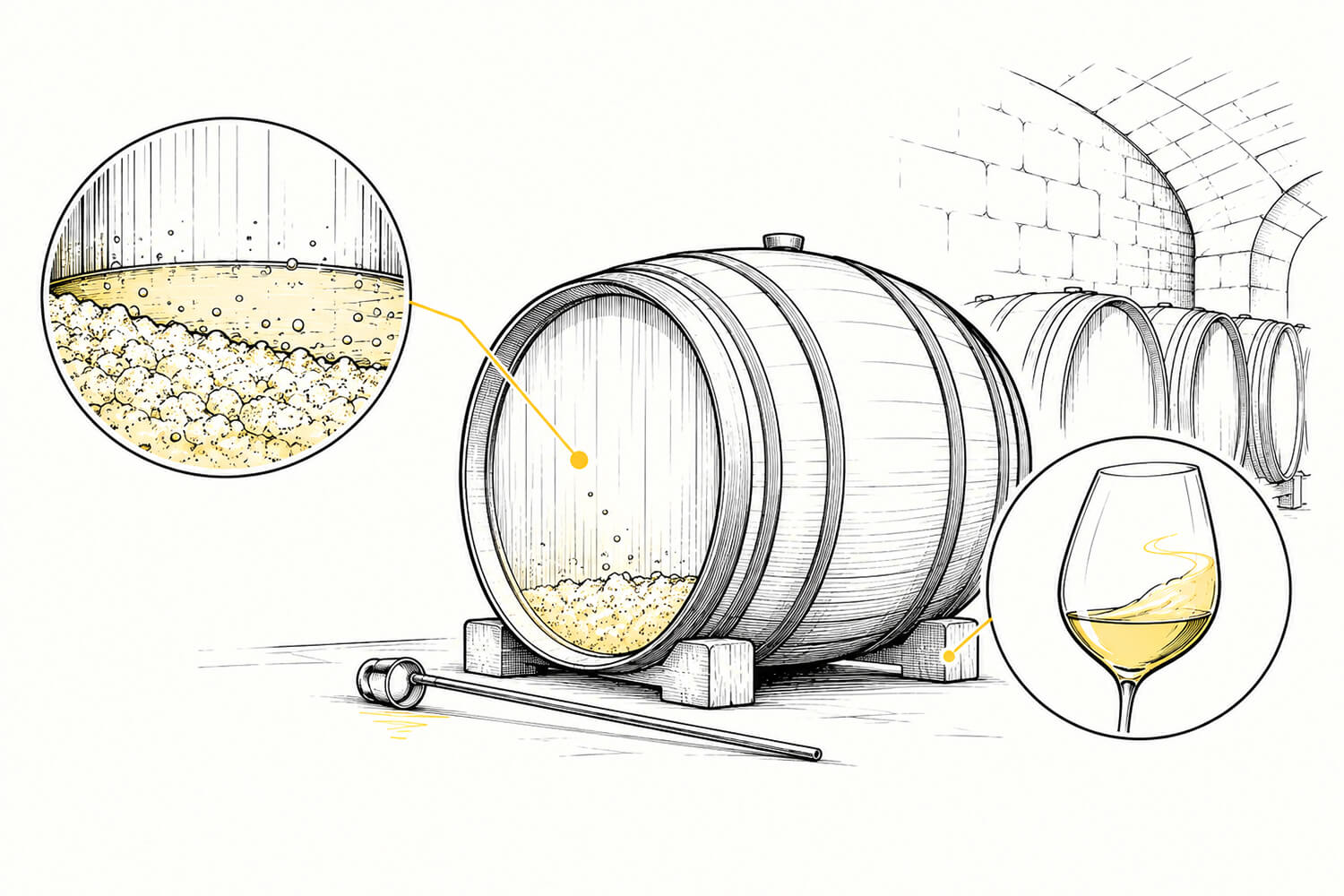
After fermentation, yeast cells die and gradually settle at the bottom of the barrel or tank together with other fine particles. This sediment is known as the lees, or lies in French. There is an important distinction between coarse and fine lees. Coarser sediment may be removed relatively early, while the finer lees can remain in contact with the wine for months. Rather than being unwanted waste, these fine lees can become an important part of maturation.
Ageing sur lie
A wine described as being aged sur lie has remained in contact with its lees during élevage. Over time, the dead yeast cells slowly break down in a natural process known as autolysis. Compounds released during this process can influence the wine’s texture, stability and flavour. For Chardonnay, lees ageing can contribute a rounder, more layered texture while adding subtle savoury or bread-like complexity. Importantly, it does not necessarily make a wine heavy. In the hands of a skilled producer, extended lees contact can coexist with remarkable freshness and precision. This technique is particularly important for many white wines from the Côte de Beaune.
What is bâtonnage?
During élevage, a winemaker may periodically stir the lees back into the wine. This is called bâtonnage. Traditionally, a tool is inserted through the barrel’s bung hole and used to stir the sediment that has collected at the bottom. This increases contact between the wine and its lees. Bâtonnage can add richness and texture, but its use varies enormously between producers. Some domaines stir frequently. Others use it only during particular stages of ageing, while some avoid it almost completely. Vintage conditions also matter. A producer may choose less bâtonnage in a naturally rich year and more in a vintage where additional texture is desirable.
More than time in barrel
Élevage should not be confused with barrel ageing alone. A wine can undergo élevage in oak barrels, larger wooden vessels, stainless-steel tanks, concrete or a combination of these. During this period, the winemaker makes a series of decisions. The wine may be moved from one vessel to another, topped up to replace wine lost through evaporation, tasted repeatedly and eventually prepared for bottling. The duration varies too. Some Bourgognes are bottled relatively quickly to preserve their immediate fruit and freshness. More ambitious wines may undergo a considerably longer élevage before the producer considers them ready.
Élevage for Pinot Noir
Lees are most commonly discussed in relation to Chardonnay, but élevage is equally important for red Bourgogne. Young Pinot Noir can initially have pronounced fruit, tannins and components that have not yet fully come together. Time in barrel or another vessel allows the wine to evolve slowly. Tannins can become more integrated, aromas develop and the different elements of the wine begin to form a more coherent whole. The producer’s objective is not necessarily to add something to the wine. Often, élevage is about giving it enough time to find its balance.
A quiet stage of winemaking
Harvest and fermentation are dramatic moments. Élevage is much quieter. For months, apparently little happens in the cellar. Yet the decisions made during this period can have a substantial influence on the finished Bourgogne. How long should the wine remain on its lees? Should they be stirred? Which vessel should be used? When should the wine be moved? And, ultimately, when is it ready to bottle? There is no single correct answer. That is perhaps the best way to understand élevage: not as one winemaking technique, but as the entire process of guiding a young wine from the end of fermentation towards the bottle. In great Bourgogne, the aim is usually not to leave an obvious winemaking signature. It is to help the wine develop without losing the character of the vineyard from which it came.