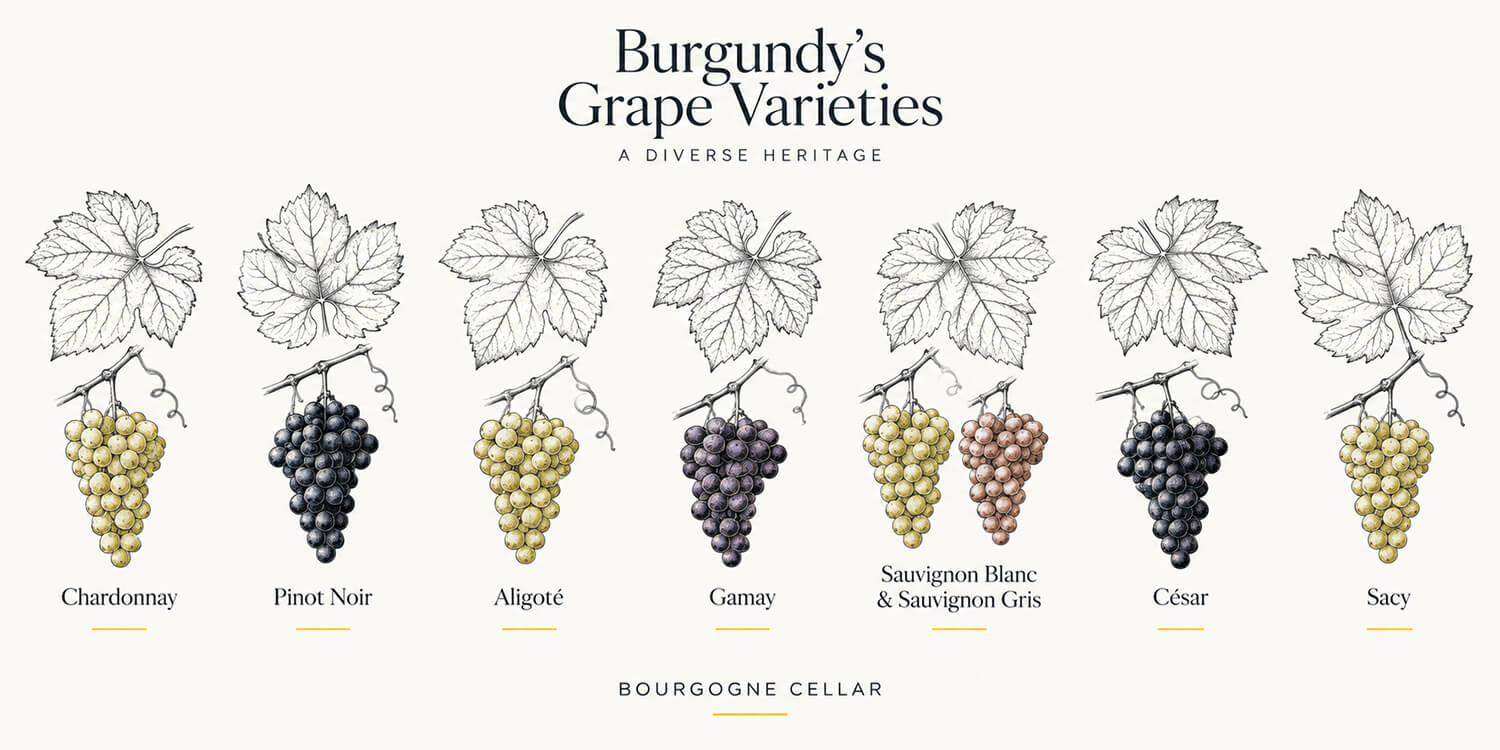
Chardonnay, Pinot Noir and Aligoté define modern Bourgogne. But hidden among the vineyards of the Yonne survives a grape that tells a very different story. Sacy was once widely planted in northern Bourgogne. Today, only tiny quantities remain. For most wine drinkers it is completely unknown, and even within Bourgogne it came remarkably close to disappearing. Yet a handful of growers are keeping Sacy alive — and some are planting it again. This is Bourgogne’s true cépage oublié: a forgotten grape with a surprisingly long history.
An old grape of the Yonne
Sacy has been associated with the Yonne for centuries. Tradition holds that monks from the Abbey of Reigny, near Vermenton, brought the variety to the area during the Middle Ages. The precise story is difficult to prove, but historical sources confirm that Sacy became firmly established in the region. Modern DNA research gives us a clearer picture of its ancestry. Like Chardonnay, Aligoté and Gamay, Sacy is a natural offspring of Pinot and Gouais Blanc.
At one time it was anything but rare. Sacy became so widespread in the Yonne that there were even attempts to restrict its cultivation in the eighteenth century. It was productive, which made it attractive to growers but did little for its reputation among those seeking more concentrated wines. Then came phylloxera. When Bourgogne’s vineyards were replanted after the devastation of the late nineteenth century, priorities changed. Sacy gradually lost ground to varieties considered more commercially or qualitatively attractive. During the twentieth century its decline continued. Chardonnay ultimately became the undisputed white star of northern Bourgogne.
Almost disappearing
Today Sacy survives on only a tiny scale in the Yonne. Historically it also found another home farther west, around Saint-Pourçain, where the same variety is better known as Tressallier. For a long time, its future in Bourgogne looked uncertain. But something interesting is happening. A small number of growers in the Yonne have deliberately preserved old Sacy vines or started propagating the variety again. Around Chitry, where Sacy has deep historical roots, producers including Domaine Giraudon still maintain small plantings. The Chalmeau family also has a long history with the variety around Chitry. Céline and Frédéric Gueguen have gone even further. Their old Sacy parcel traces back to vines planted by Céline’s grandfather, and in 2018 they planted additional Sacy using material selected from the existing vines. They bottle a rare 100% Sacy under the Coteaux Bourguignons appellation. It is preservation through drinking.
What does Sacy taste like?
Sacy generally produces light, dry and distinctly fresh white wines. Expect green apple, citrus, white flowers and sometimes pear or peach, accompanied by lively acidity and a clean, slightly saline or mineral character. Alcohol levels tend to remain relatively modest. A 100% Sacy from Edmond Chalmeau, for example, has been described with floral, peach and pear aromas alongside freshness and minerality. This is not Chardonnay in disguise. Sacy tends to be more direct and energetic, without the weight or breadth that Chardonnay can achieve. That freshness also makes it interesting for sparkling wine; the variety remains permitted in Crémant de Bourgogne.
An old grape with a possible future
There is a certain irony to Sacy’s story. Characteristics that once worked against it — high acidity, relatively modest alcohol and late development — suddenly look rather interesting in an era of warmer growing seasons. In the Yonne, its later cycle can also help it escape some spring-frost events. Nobody should expect Sacy to reclaim the vineyards of Chablis from Chardonnay. Its future will almost certainly remain small.
But perhaps that is beside the point. The renewed interest in Sacy reflects something happening throughout the wine world: growers are looking again at old varieties that previous generations abandoned. Not because they are necessarily better, but because they offer diversity, history and another expression of a place. For Bourgogne lovers, Sacy is therefore more than a curiosity. Every surviving bottle connects today’s Yonne with a nearly forgotten Bourgogne — one in which the vineyards contained far more than Chardonnay.