Sauvignon Blanc is hardly the first grape that comes to mind when thinking about Bourgogne. Chardonnay dominates the region’s white wines, with Aligoté providing its most important alternative. Yet in the far north of Bourgogne, Sauvignon has established a small and fascinating exception. Around the village of Saint-Bris-le-Vineux, close to Auxerre and southwest of Chablis, Sauvignon Blanc and Sauvignon Gris are responsible for a distinctly different style of white Bourgogne.
The exception in Bourgogne
Saint-Bris is unusual because it is the only Bourgogne appellation centred on Sauvignon. The vineyards form part of the Grand Auxerrois, an area where several grape varieties coexist. Chardonnay and Pinot Noir remain important in the surrounding vineyards, but wines carrying the Saint-Bris AOC designation are produced from Sauvignon Blanc and Sauvignon Gris. Saint-Bris received its own AOC in 2003, replacing the earlier Sauvignon de Saint-Bris designation. For anyone familiar with Bourgogne labels, finding Sauvignon here can initially be surprising. But the variety has a long history in the Auxerrois and is well suited to this relatively cool northern environment.
What does Saint-Bris taste like?
Sauvignon from Bourgogne generally shows a fresh, dry and aromatic character. Typical aromas can include citrus, grapefruit, green apple and white flowers, alongside herbal notes and sometimes blackcurrant leaf. The wines usually have lively acidity and are intended to retain a clear sense of freshness. Yet Saint-Bris does not necessarily taste like Sauvignon from the Loire Valley or New Zealand. The limestone-rich soils and cool continental conditions of northern Bourgogne can give the wines a restrained, stony character. The best examples combine Sauvignon’s natural aromatic personality with the precision and freshness associated with this part of Bourgogne.
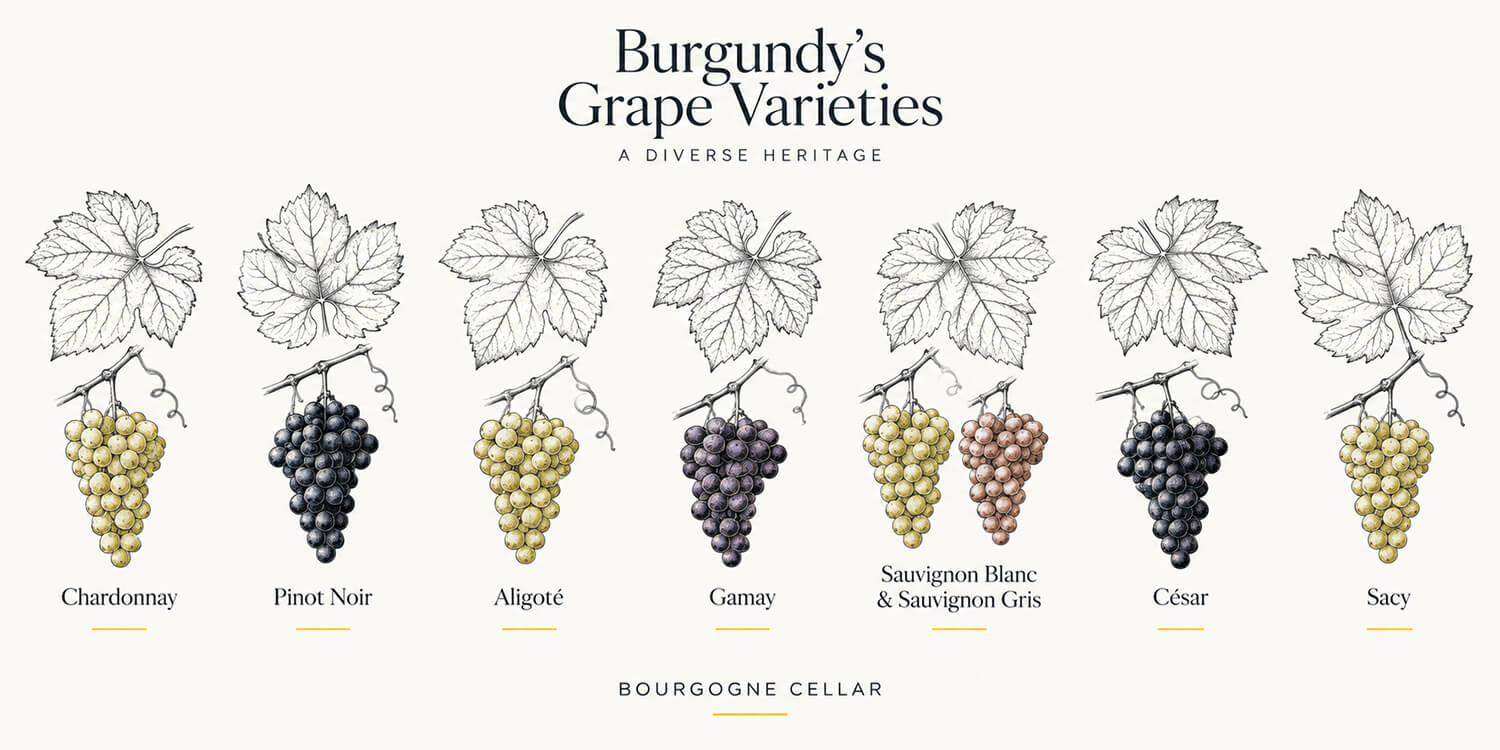
Sauvignon Blanc and Sauvignon Gris
Sauvignon Blanc is by far the better-known of the two permitted varieties. Sauvignon Gris is a colour mutation of Sauvignon Blanc. Its berries have pinkish-grey skins and it can produce wines with slightly more body and richness than Sauvignon Blanc. The two may be used together in Saint-Bris, although their exact proportions depend on the producer and vineyard. This gives growers another tool for balancing aromatic freshness with texture and concentration.
In the vineyard and cellar
Sauvignon is relatively vigorous, so controlling growth and yields is important. In the cool climate around Saint-Bris, vineyard exposure and achieving sufficient ripeness also play an important role. Winemaking generally aims to preserve freshness and aromatics. Stainless steel is therefore common, although individual producers may use other vessels or longer ageing to create more textured interpretations. Heavy oak is rarely the defining feature. Saint-Bris is at its most recognisable when the wine remains bright, aromatic and energetic.
A Bourgogne outsider
Sauvignon Blanc and Sauvignon Gris occupy only a tiny corner of the Burgundian wine landscape. That is precisely what makes them interesting. Saint-Bris demonstrates that Bourgogne is more diverse than its reputation for Chardonnay and Pinot Noir might suggest. For curious Bourgogne drinkers, it offers something genuinely different: the freshness and aromatic character of Sauvignon interpreted through a distinctly northern Bourgogne landscape.