Bourgogne can seem complicated. Hundreds of vineyard names, dozens of appellations and labels filled with unfamiliar French terminology can make the region difficult to navigate. Yet behind this complexity lies a surprisingly logical system. At its heart, the Bourgogne classification system is about geographical precision. The closer a wine can be linked to a particular place, the further it moves up the traditional hierarchy.
A hierarchy based on place
Unlike many wine classifications that focus primarily on producers or estates, Bourgogne largely classifies the geographical origin of the wine. The system is generally divided into four levels:
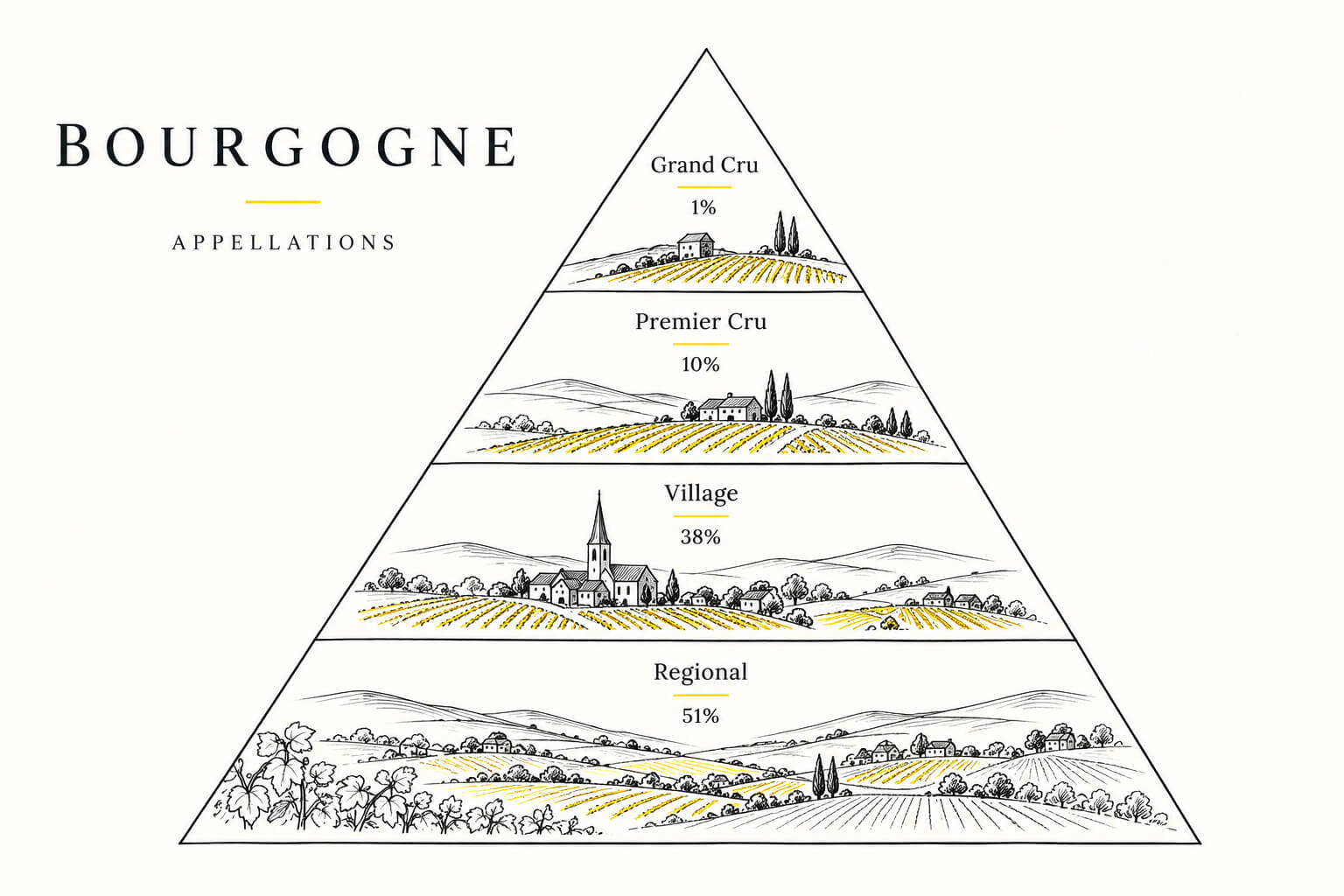
Regional wines represent the broadest geographical origin. Village wines come from vineyards associated with a particular village. Premier Cru takes us further, to recognised vineyard sites within a village, while Grand Cru represents a small number of vineyards at the top of the classification. As you move upwards, the permitted geographical area generally becomes smaller and more precisely defined.
This is an important principle. A Grand Cru is not simply a wine that passed a tasting test and was awarded a higher score. Its status is connected to the land from which it comes.
Why classify vineyards?
The hierarchy did not appear from nowhere. Long before today’s formal system existed, growers, landowners and merchants knew that certain vineyards consistently enjoyed stronger reputations than others. Some sites offered particularly favourable combinations of slope, exposure, drainage and geology. Over generations, these differences became reflected in reputation and wine prices.
The modern classification system formalised much of this historical understanding. It is therefore useful to think of Bourgogne’s hierarchy not simply as four quality categories, but as the result of centuries of observing differences between places.
Higher does not always mean better
The hierarchy is useful, but it should never be treated as an absolute quality ranking. A Premier Cru is classified above a Village wine, and a Grand Cru occupies the highest level. But this does not guarantee that every Grand Cru will be more enjoyable than every Premier Cru.
The producer remains enormously important. Vineyard management, yields, harvest date, winemaking and élevage can all influence the final wine. Vintage conditions matter too. An exceptional producer can make a superb Village wine, while a prestigious vineyard does not automatically produce a great bottle. Classification tells you about the recognised status and origin of the vineyard. It does not replace the name of the producer.
A useful way to understand Bourgogne
For wine lovers, the classification system provides a framework for exploring the region. You can start broadly with regional Bourgogne and gradually move towards individual villages and vineyards. As the geographical focus becomes narrower, differences in terroir become increasingly fascinating. That is ultimately what the Bourgogne classification system is designed to preserve: the idea that wines from different pieces of land can have their own identity.
Understanding the hierarchy makes Bourgogne considerably less intimidating. Instead of seeing a confusing collection of names, you begin to see a map — one that moves from an entire region towards some of the most precisely defined vineyards in the world.