On Bourgogne labels you will occasionally find the words Vieilles Vignes — literally, old vines. The term has considerable appeal. Old vines suggest deep roots, tiny yields and concentrated wines from vineyards that have survived for generations. There is certainly some truth behind that image. But Vieilles Vignes is also a term that needs context. Unlike an appellation or Premier Cru classification, it does not represent a specific quality level.
What does Vieilles Vignes mean?
There is no single legally defined minimum age in Bourgogne that automatically makes a vineyard Vieilles Vignes. One producer might use the term for vines that are 40 years old, while another reserves it for parcels planted 60, 80 or even more than 100 years ago. Some domaines do not use the term at all, despite owning very old vineyards. The words on the label should therefore be regarded primarily as information provided by the producer, rather than an official classification. If the precise age matters, the domaine itself is usually the best source.
Why are old vines valued?
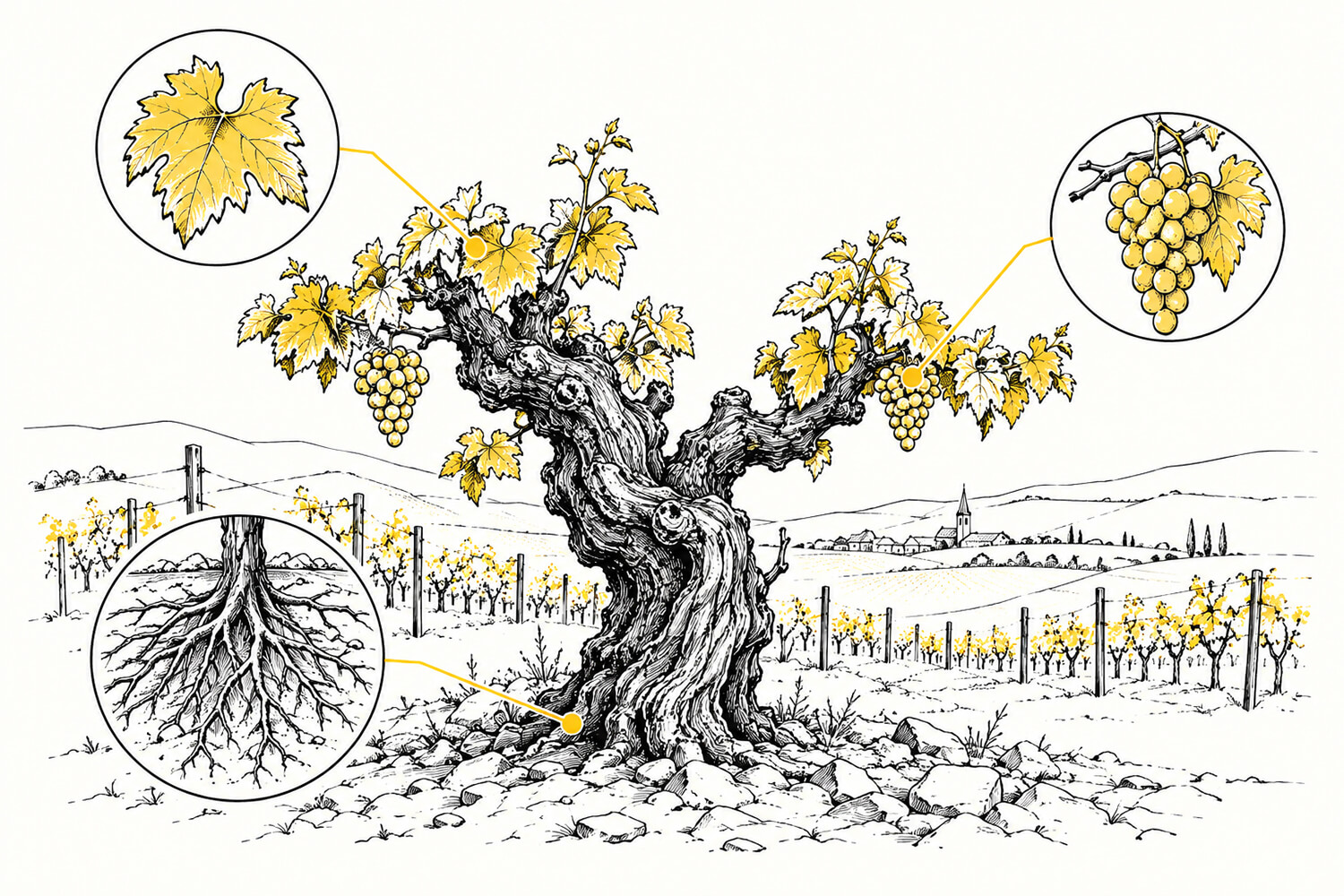
As vines mature, their behaviour changes. Older vines generally become less vigorous and can naturally produce smaller crops. Their established root systems explore a considerable volume of soil and may help the plant cope with variations in water availability. For the grower, an old vineyard can also offer something less easily measured: balance. A mature vine that has adapted to its site over many decades can produce relatively small quantities of grapes with an attractive relationship between ripeness, acidity and concentration. This is one reason old vines are particularly prized in a region so focused on individual vineyard sites.
Do old vines have deeper roots?
Often, but this familiar claim requires some nuance. A 70-year-old vine has had much more time to establish its root system than a newly planted vine, but roots do not simply grow straight down into the earth. Their development depends on geology, soil depth, water, competition and vineyard management. Bourgogne’s limestone-rich vineyards can have remarkably complex underground structures. The importance of old vines is therefore not simply that their roots are deeper. It is that they have developed a mature root system adapted to their particular environment.
Smaller yields, greater concentration?
Old vines are frequently associated with lower yields and more concentrated grapes. Again, this is possible rather than guaranteed. Yield also depends on pruning, vintage conditions, vine health and decisions made by the grower. A carefully managed younger vineyard can produce exceptional fruit, while an old vineyard in poor condition will not magically produce great wine. Age alone is never enough.
A connection with Bourgogne’s past
Perhaps the most fascinating aspect of old vines is their continuity. Some parcels have survived changes in ownership, difficult vintages and generations of growers. Occasionally, particularly old vineyards also preserve genetic diversity through historic selections of vines that differ subtly from today’s more uniform planting material. For a region built around the idea that tiny pieces of land possess individual identities, these old plantings can be an important part of a domaine’s heritage. It also explains why growers sometimes go to considerable lengths to preserve them.
Does Vieilles Vignes mean better Bourgogne?
Not necessarily. A bottle marked Vieilles Vignes may indeed come from exceptionally old vines and offer remarkable depth and complexity. But the term itself is not a guarantee of superior wine, nor does it outrank a bottle without those words. Producer, vineyard, vintage and vineyard management remain far more important. Think of Vieilles Vignes as an intriguing extra piece of information. It tells you that the producer considers the age of the vines significant enough to mention. In Bourgogne, where history can sometimes be measured vine by vine, that can make a bottle particularly interesting.