If you explore Bourgogne wine for any length of time, you will quickly encounter the word appellation. It appears on labels, in wine lists and in almost every discussion about the region. Yet an appellation is more than simply the place where a wine comes from. In Bourgogne, appellations form the geographical and legal framework of the wine region. They determine where grapes may be grown, which varieties may be used and under what conditions a wine can carry a particular geographical name. Behind those rules lies a much older idea: that the origin of a wine matters.
Understanding appellations therefore makes Bourgogne considerably easier to understand. It explains why two vineyards separated by a road can produce wines carrying different names, why Chardonnay grown in one village may be worth considerably more than Chardonnay grown a few kilometres away, and why Bourgogne labels tend to emphasise places rather than grape varieties. An appellation is, in essence, Bourgogne’s way of putting origin into words.
What exactly is an appellation?
An appellation is a legally defined geographical designation for agricultural products. In wine, it links a wine to a particular area and establishes rules governing its production. The French system is generally associated with the term Appellation d’Origine Contrôlée, or AOC. Today, the European framework also uses Appellation d’Origine Protégée (AOP), or Protected Designation of Origin. In everyday wine language, however, AOC and appellation remain widely used.
An appellation does not simply say “this wine was made somewhere around here.” Its boundaries are precisely defined. Depending on the appellation, regulations can specify permitted grape varieties, vineyard practices, maximum yields, minimum potential alcohol levels, planting densities, pruning methods and other aspects of production.
A producer cannot simply purchase a vineyard in Bourgogne, plant Chardonnay and put the name of the nearest famous village on the bottle. The vineyard must actually fall within the officially recognised appellation boundaries, and the wine must comply with the applicable production rules. This makes an appellation both a place and a set of rules.
Bourgogne existed long before the AOC system
The modern appellation system is relatively young. Bourgogne’s understanding of different vineyard origins is not. Wine has been produced in Bourgogne for many centuries. Over generations, growers, landowners, monasteries and merchants observed that certain sites consistently produced distinctive wines. Differences in slope, exposure, drainage, soil and local climate became increasingly recognised.
Monastic communities played an important role in this process during the Middle Ages. Large landholdings allowed monks to observe vineyards over very long periods. The Cistercians in particular are often associated with Bourgogne’s historical understanding of individual vineyard sites.
But Bourgogne’s vineyard landscape was shaped by many people and over many centuries. Monks did not suddenly invent terroir. Rather, knowledge accumulated gradually through farming, observation, ownership, trade and repeated experience. By the nineteenth century, Bourgogne already possessed a remarkably detailed hierarchy of vineyard reputations. Certain villages were famous. Within those villages, certain vineyards commanded higher prices than others.
The modern appellation system would eventually formalise much of this existing geographical knowledge.
Why was legal protection necessary?
Today, seeing the name of a famous wine region on a bottle feels normal. Historically, geographical wine names were not always so well protected.cDuring the late nineteenth and early twentieth centuries, the French wine industry experienced enormous disruption. Phylloxera devastated vineyards. Fraud and adulteration became serious concerns. Wines could be sold under prestigious geographical names despite having little or no connection to those places.
For regions whose reputation depended on origin, this was a major problem. France gradually developed legislation protecting geographical wine names and defining where wines bearing those names could actually come from. A decisive step came in 1935, when the system that became the modern Appellation d’Origine Contrôlée framework was established.
The newly created national organisation responsible for appellations — the predecessor of today’s INAO — helped formalise production areas and rules. Bourgogne was particularly suited to such a system because geographical distinctions were already deeply embedded in its wine culture. The law did not create Bourgogne’s terroirs. It attempted to define and protect them.
Drawing a line through a vineyard landscape
One of the most fascinating aspects of an appellation is also one of the most controversial: somewhere, a boundary has to be drawn.cImagine a hillside covered with vines. The geology does not suddenly change because somebody has drawn a line on a map. Soil layers continue underground. Exposure changes gradually. Water drainage does not recognise administrative borders.cYet an appellation needs precise boundaries. This means translating a complex natural and historical landscape into legally defined parcels of land.
In Bourgogne, this can become extraordinarily detailed. A vineyard parcel on one side of a path may qualify for one designation while another parcel nearby falls under another. In some places, seemingly small differences in elevation, slope or historical classification can have major consequences for the name that appears on the bottle.
These boundaries are not arbitrary in the sense that somebody simply drew circles around prestigious villages. They generally reflect combinations of historical usage, vineyard reputation, geology, topography and established viticultural practice. But they are still human definitions imposed upon a natural landscape. That tension is part of what makes Bourgogne so interesting.
Appellation is not the same as terroir
The two concepts are closely related, but they should not be confused. Terroir is the broader idea that a wine reflects the environment in which the grapes were grown. This can include soil, geology, slope, altitude, exposure, drainage and local climatic conditions, together with the interaction between these factors and viticulture.
An appellation is a legal designation.
Terroir exists in the vineyard. An appellation exists in law.
Ideally, the boundaries of an appellation capture meaningful differences in terroir and historical identity. In Bourgogne, they often do so remarkably precisely. But nature is more complicated than legislation. Two parcels within the same appellation can produce very different wines. Conversely, vineyards separated by an appellation boundary can sometimes share geological characteristics. This is important when tasting a Bourgogne. The appellation tells you a great deal about where a wine comes from, but it does not tell you everything about the wine.
A hierarchy of origin
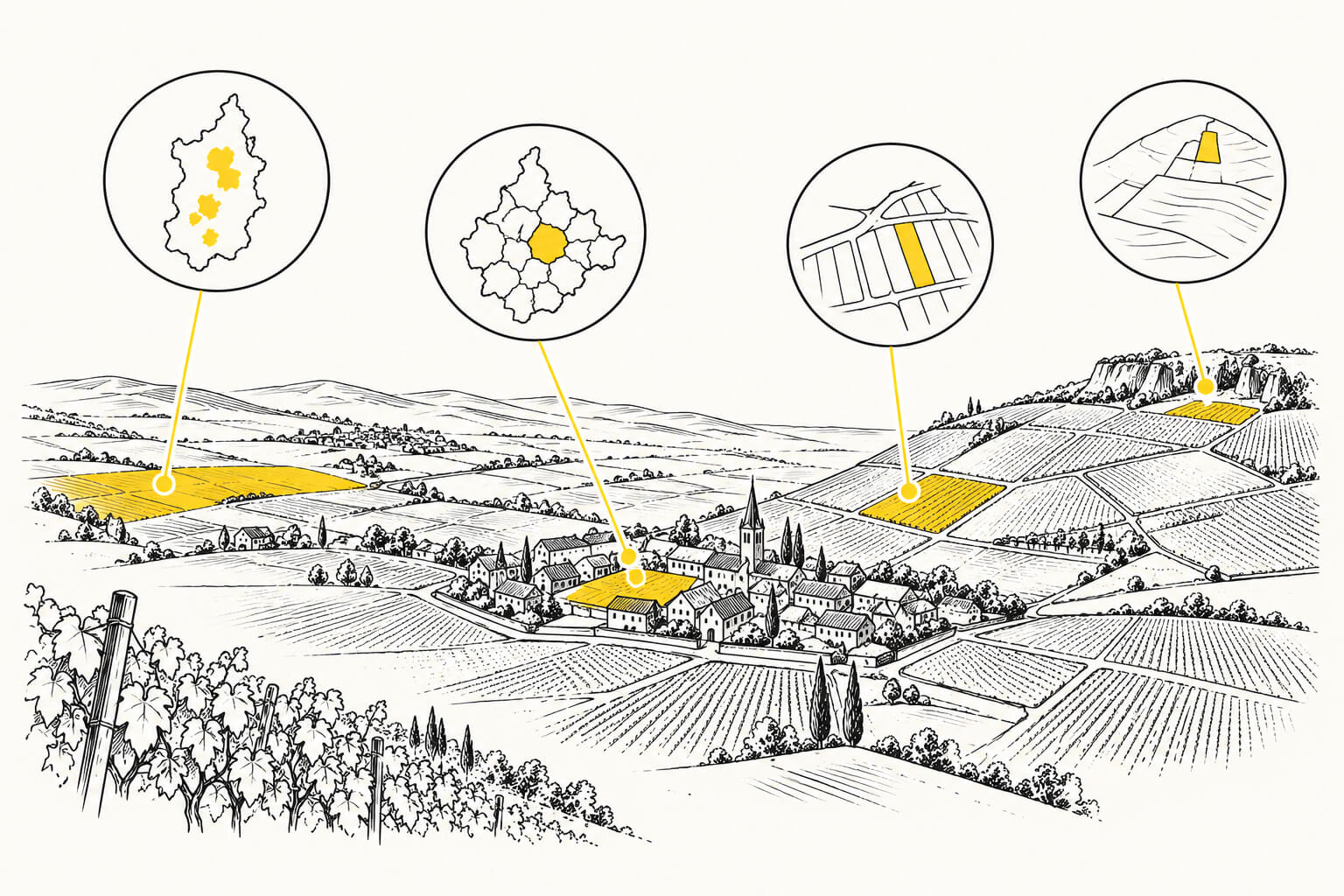
Bourgogne’s appellation system becomes particularly interesting because geographical origin is expressed at different levels of precision. At its broadest, a wine can represent Bourgogne as a region. At a more precise level, it may originate from a defined subregional area or village. Within certain villages, recognised vineyard sites can receive higher classifications. At the narrowest end of the spectrum are highly specific vineyards whose names effectively function as appellations in their own right.
This creates the familiar Burgundian hierarchy from broader regional wines through village and Premier Cru wines to Grand Cru. The important principle is that as you move through this hierarchy, the geographical origin generally becomes more precise. Think of it as progressively zooming in on a map.
Bourgogne → area → village → vineyard → parcel
Not every step is formally represented in exactly this way on a wine label, but the principle explains much of Bourgogne. This is also why Bourgogne is fundamentally different from wine regions where the producer or grape variety dominates the label. Here, increasingly precise origin is at the centre of the system.
Why no grape varieties on the label?
Someone new to Bourgogne might pick up a bottle and wonder where the words Pinot Noir or Chardonnay are. Often, they are nowhere to be found on the front label. For Bourgogne drinkers, the appellation frequently provides that information indirectly. Regulations define which grape varieties can be used for particular wines, so the geographical name itself carries a considerable amount of information.
This reflects a fundamental difference in philosophy. A label saying Chardonnay primarily tells you what the wine is made from. An appellation tells you where it comes from. Bourgogne places enormous importance on the second question. The grape variety remains essential, of course. But Pinot Noir and Chardonnay are relatively transparent vehicles for differences in origin. Bourgogne’s fascination lies precisely in observing how the same grape variety behaves differently from one place to another.
Appellations also protect names
An appellation has economic value. Famous wine names have been built over generations and sometimes centuries. Without legal protection, producers elsewhere could benefit from that reputation simply by putting a prestigious geographical name on their bottles. Appellation law prevents this.
A protected Bourgogne appellation can only be used for wine entitled to that designation. This protects producers, but it also protects consumers. When you buy a bottle carrying a recognised appellation, you know that its origin is not merely a marketing claim. This became increasingly important as Bourgogne developed into a global fine-wine market. Some Bourgogne names today carry enormous commercial value. The appellation system ensures that those names remain connected to actual land.
Does a ‘higher’ appellation automatically mean a better wine?
No, and this is where Bourgogne becomes much more interesting than its hierarchy initially suggests. Classification indicates the recognised status and origin of a vineyard or area. It does not guarantee that every bottle from that appellation will be superior to every bottle from a lower classification.
The producer matters enormously. So do vintage, vineyard management, vine age, yields, harvest decisions, winemaking and élevage. Individual parcels within the same appellation can also differ considerably. A talented grower working an excellent parcel in a modest appellation can produce a more exciting wine than a less accomplished producer working land with a more prestigious classification.
This is one reason experienced Bourgogne drinkers rarely buy on appellation alone. The name on the label provides the geographical framework. The producer tells you who interpreted that place.
The importance of the producer
Bourgogne is extraordinarily fragmented. A single vineyard can be divided among numerous owners, sometimes with each domaine farming only a small number of rows. The wines may legally carry exactly the same appellation, yet taste noticeably different.
One grower may farm organically. Another may follow conventional methods. Harvest dates can differ. Yields can differ. One producer may use a substantial proportion of new oak, another almost none. Whole-cluster fermentation, extraction, pressing and maturation can all vary.
The appellation therefore establishes a common geographical identity without creating uniformity. That is a crucial distinction. Appellation does not mean recipe. Two bottles carrying the same appellation can represent two very different interpretations of the same place. For wine lovers, that is not a flaw in the system. It is one of Bourgogne’s great attractions.
The role of the climat
To understand why appellations work so well in Bourgogne, it helps to know another Burgundian term: climat. In everyday English, climate refers to weather patterns. In Bourgogne, a climat has a much more specific meaning. It is a precisely identified vineyard site with its own name, history and recognised characteristics.
Bourgogne contains hundreds of these named vineyard sites. Some have become internationally famous. Others are known mainly to growers and dedicated Bourgogne enthusiasts. Their boundaries can reflect centuries of observation and land use.
The importance of these individual vineyard sites is so fundamental to Bourgogne that the Climats of the Bourgogne vineyards were inscribed on UNESCO’s World Heritage List in 2015. The appellation system and the concept of climats are not identical, but they overlap. Together they demonstrate the extraordinary extent to which Bourgogne has organised its wine culture around geographical origin.
Why Bourgogne has so many appellations
From the outside, Bourgogne can look unnecessarily complicated. Why so many names? Why so many boundaries? Why not simply sell everything as Pinot Noir and Chardonnay from Bourgogne?
Because doing so would remove much of the information that Bourgogne has spent centuries identifying. The region is not one uniform vineyard. Differences occur over surprisingly short distances. A change in slope, exposure or geological layer can alter drainage, ripening and ultimately the character of a wine.
Bourgogne’s complicated system is therefore partly the result of taking those differences seriously. The complexity has a purpose. It preserves geographical information. Once you understand that, Bourgogne becomes less confusing. The many names are no longer obstacles to memorise. They are coordinates.
An appellation is not a guarantee of style
There is another useful misconception to avoid. Appellations often develop recognisable stylistic associations, but these should not be treated as rigid tasting formulas. A particular place may commonly produce wines associated with elegance, power, minerality, richness or structure. Such descriptions can be useful. But vintage conditions, producer style and individual vineyard characteristics can easily complicate these generalisations.
Appellation rules control origin and production parameters. They do not dictate exactly what a wine must taste like. This leaves room for variation — and for personality. That is why tasting several producers from the same appellation can be so educational. Instead of simply asking whether the wines taste alike, you can ask what they share despite being made differently. That question takes you much closer to the idea of terroir.
The label as a map
Once you understand appellations, a Bourgogne label starts to look different. At first, the label can appear to be a collection of unfamiliar French names. But many of those names are geographical clues. They tell you how precisely the origin of the wine has been defined.
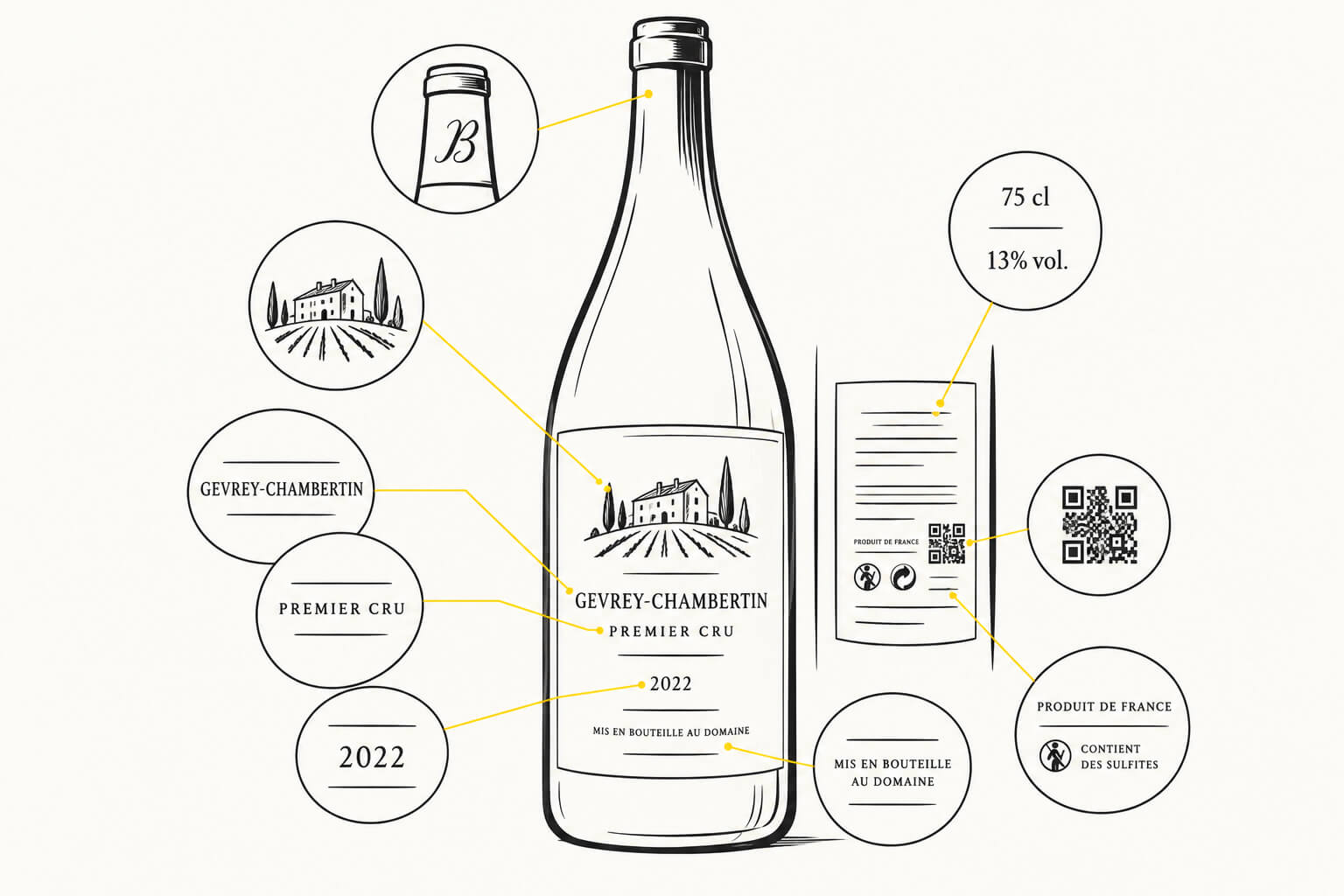
The producer tells you who made the wine.
The vintage tells you when the grapes were grown.
The appellation tells you where they were grown.
Additional vineyard names can sometimes take you even deeper into that origin.
A Bourgogne label is therefore almost a miniature map. Learning to read it is one of the most useful skills for anyone interested in the region.
Appellations and scarcity
Geographical precision also explains much of Bourgogne’s scarcity. An appellation cannot simply expand production because demand increases. Its vineyard area is geographically limited. This is particularly significant at the more prestigious end of Bourgogne. Some highly regarded appellations cover very small areas. Production is constrained by the amount of land available and by permitted yields.
If global demand for a wine doubles, the vineyard does not double in size. This basic fact lies behind much of the economics of fine Bourgogne. Land within famous appellations can consequently become extraordinarily valuable. A few metres can make an enormous economic difference if they separate land entitled to different appellations.
For collectors, appellation is therefore not only about taste. It is closely connected to rarity.
But lesser-known appellations can be fascinating
The same system that creates extremely expensive wines also creates opportunities. Prestige is unevenly distributed. Some names attract global demand while others remain relatively overlooked. Yet appellation boundaries do not divide Bourgogne into good wine and bad wine.
This becomes particularly interesting as vineyard quality improves, producers become more ambitious and warmer vintages alter the potential of sites that historically struggled to ripen consistently. For Bourgogne enthusiasts, looking beyond the most famous appellations can therefore be rewarding. The appellation system gives you a framework for exploring these differences rather than simply following price or reputation.
A less prestigious name in the hands of an excellent grower can offer a remarkable insight into Bourgogne — and sometimes considerably better value.
A living system
Appellations can feel ancient and immutable, but the system is not frozen in time. Regulations can evolve. Production rules can be amended. Vineyard classifications and geographical definitions can be debated. Climate change is also forcing Bourgogne to reconsider practices that developed under different conditions.
This creates an interesting tension. An appellation exists partly to preserve identity and tradition. At the same time, winegrowers need enough flexibility to respond to changing conditions. Bourgogne today is warmer than it was during many periods in which its traditional viticultural practices developed. Harvest dates have shifted, ripening patterns have changed and growers increasingly think about how to preserve freshness and balance.
The challenge for the appellation system is therefore not simply to preserve the past. It is to protect geographical identity while allowing Bourgogne to remain a living wine region.
Bourgogne is a geography of wine
The appellation system can initially seem bureaucratic: boundaries, regulations, classifications and French terminology. But underneath all of that administration is a beautifully simple idea: where a wine comes from matters.
Bourgogne has taken that idea further than almost any other wine region. Instead of treating origin as a broad regional concept, it has divided its vineyard landscape into increasingly precise pieces, preserving generations of knowledge about individual places. The system is imperfect. Nature does not always respect lines on maps, prestigious classifications do not guarantee great bottles, and a talented producer can make extraordinary wine from relatively humble origins.
Yet that imperfection is also what keeps Bourgogne interesting. An appellation gives us a framework. The vineyard, vintage and winemaker fill in the details.
Once you begin to see Bourgogne through that framework, the seemingly endless collection of names becomes much more logical. Each appellation is another piece of the same puzzle: an attempt to understand how a particular piece of land can find its way into a glass of wine.