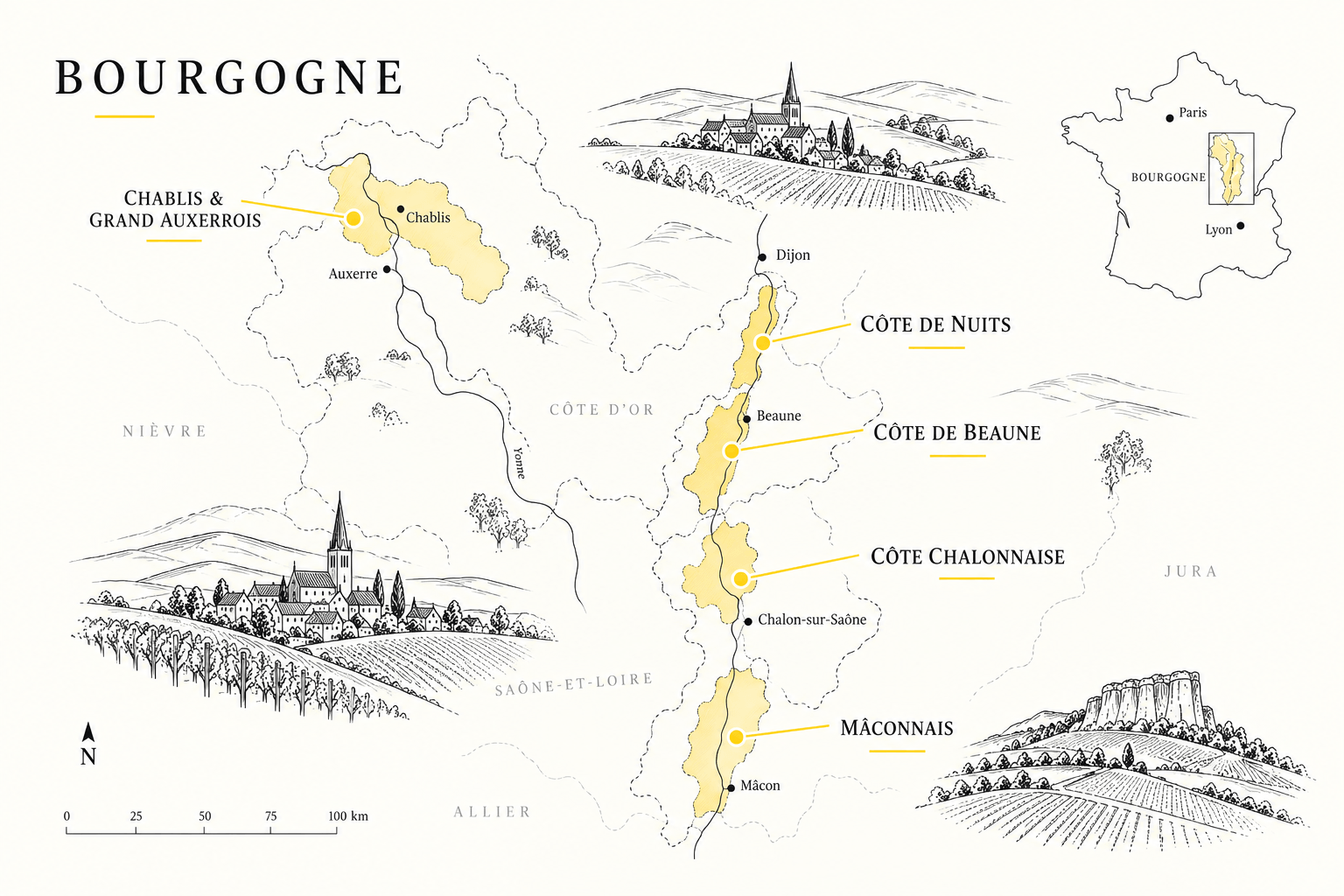
The Côte de Beaune forms the southern half of Bourgogne’s Côte d’Or, continuing south from the Côte de Nuits. It is one of the world’s great regions for both Chardonnay and Pinot Noir, with an extraordinary collection of famous villages and vineyards packed into a relatively narrow strip of land. If the Côte de Nuits is primarily associated with great Pinot Noir, the Côte de Beaune has a more varied identity. It is home to legendary white wines from Meursault, Puligny-Montrachet and Chassagne-Montrachet, but also to some of Bourgogne’s finest reds from places such as Pommard and Volnay.
A landscape built around Beaune
The region takes its name from Beaune, the historic wine capital of Bourgogne. Vineyards stretch north and south of the town along slopes that generally face east and southeast. As elsewhere in the Côte d’Or, limestone and marl are fundamental to the landscape, but local variations in soil, elevation and exposure create markedly different growing conditions over short distances. Both Chardonnay and Pinot Noir thrive here. Which variety dominates often changes from one village — and sometimes one section of a hillside — to another.
The great white wines of Bourgogne
The southern Côte de Beaune contains perhaps the most celebrated Chardonnay vineyards in the world. Meursault is one of its great names. Its white wines are often associated with richness and texture, yet the best examples combine this generosity with freshness, tension and remarkable ageing potential. Interestingly, Meursault has no Grand Cru vineyards, despite its exceptional reputation. Further south, Puligny-Montrachet is renowned for Chardonnay of precision and elegance. Its finest wines can be intense without feeling heavy, combining concentration with freshness and a long, refined finish.
Neighbouring Chassagne-Montrachet is also famous for great Chardonnay, although Pinot Noir remains important in parts of the village. Together, Puligny and Chassagne share some of Bourgogne’s most prestigious Grand Cru territory. At the pinnacle stands Montrachet, one of the most celebrated white-wine vineyards in the world. Other famous Grand Crus nearby include Chevalier-Montrachet, Bâtard-Montrachet and Criots-Bâtard-Montrachet.
Pinot Noir: Pommard, Volnay and beyond
The Côte de Beaune is equally fascinating for red wine. Pommard has traditionally been associated with relatively powerful, structured Pinot Noir. The wines can have considerable depth and often benefit from bottle age. Just south lies Volnay, whose reputation is almost the opposite. Volnay is celebrated for Pinot Noir with perfume, finesse and elegance. The contrast between these neighbouring villages is a classic example of why exploring Bourgogne by place can be so rewarding.
To the north of Beaune, Aloxe-Corton and neighbouring villages surround the hill of Corton. This is an unusual part of Bourgogne because the hill produces both important red Grand Cru and the famous white Corton-Charlemagne Grand Cru. Other villages including Savigny-lès-Beaune, Pernand-Vergelesses, Saint-Aubin and Saint-Romain provide further expressions of both Chardonnay and Pinot Noir, often at more accessible prices than the most prestigious names.
Two great sides of Bourgogne
What makes the Côte de Beaune particularly compelling is its diversity. It produces profound Chardonnay and serious Pinot Noir, from relatively approachable village wines to some of the rarest and most expensive bottles in the world. For wine lovers, it is also a region where looking beyond the most famous labels can be rewarding. The celebrated names deserve their reputation, but neighbouring villages and lesser-known vineyards often offer exceptional quality.
The Côte de Beaune is therefore difficult to summarise with a single wine style. Its identity lies precisely in its combination of great white and red Bourgogne — and the remarkable differences between villages only a few kilometres apart.