
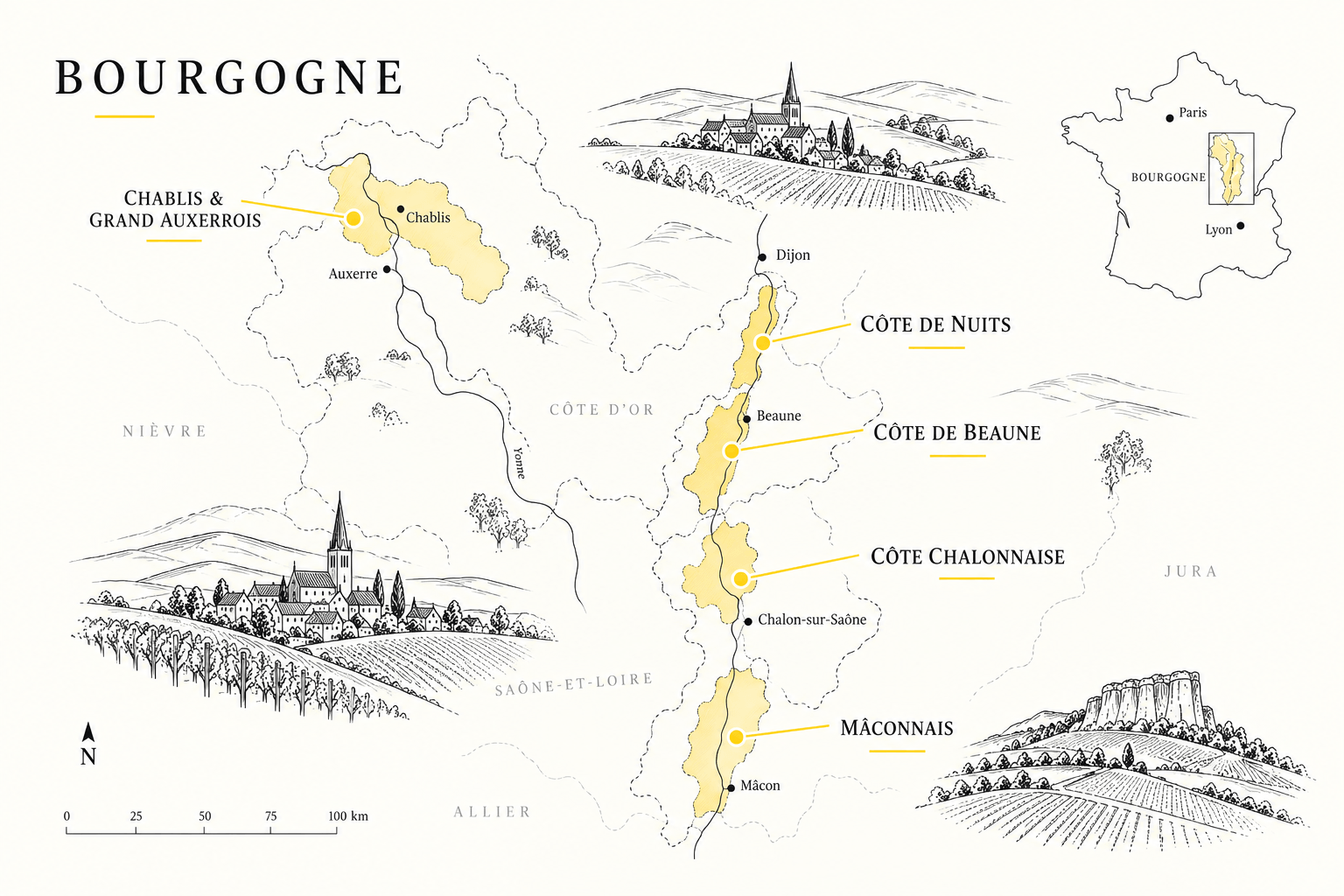
The Côte de Nuits forms the northern half of Bourgogne’s famous Côte d’Or and is one of the world’s great regions for Pinot Noir. Stretching south from Dijon towards the town of Nuits-Saint-Georges, it is a remarkably compact wine region whose vineyard names have become synonymous with fine red Bourgogne. This is the home of Gevrey-Chambertin, Chambolle-Musigny and Vosne-Romanée — and of an extraordinary concentration of Grand Cru vineyards. For lovers and collectors of Pinot Noir, few stretches of vineyard anywhere carry comparable prestige.
A narrow strip of exceptional vineyards
The Côte de Nuits is surprisingly small. Its most celebrated vineyards occupy a relatively narrow band of slopes, generally facing east or southeast and rising above the villages below. Limestone and marl play an important role, but conditions vary considerably from one location to another. Changes in slope, soil depth, drainage and exposure help create the differences that Bourgogne lovers find so fascinating.
The climate is continental, with warm summers, cool winters and significant vintage variation. Pinot Noir dominates because it is particularly capable of translating these subtle differences in origin into noticeably different wines.
The heartland of Pinot Noir
Red wine defines the Côte de Nuits. Chardonnay is grown and some interesting white wines are produced, but they represent only a small part of the region.
Pinot Noir from the Côte de Nuits can range from delicate, perfumed and silky to dark, structured and powerful. There is no single Côte de Nuits style. In fact, the differences between its villages are one of the region’s great attractions.
Gevrey-Chambertin is often associated with structured, deep and powerful Pinot Noir. It is also surrounded by an exceptional collection of Grand Crus, including Chambertin and Chambertin-Clos de Bèze. Nearby Morey-Saint-Denis combines concentration with elegance and includes famous vineyards such as Clos de la Roche, Clos Saint-Denis and Clos des Lambrays. Chambolle-Musigny has a very different reputation. Its wines are traditionally described as among the most elegant and perfumed of the Côte de Nuits, with fine texture and remarkable finesse. Musigny sits at the pinnacle of the village.
Vosne-Romanée and Nuits-Saint-Georges
Further south lies Vosne-Romanée, arguably the most prestigious wine village in Bourgogne. Its vineyards include names that have become legendary: Romanée-Conti, La Tâche, Richebourg and Romanée-Saint-Vivant. The finest wines can combine perfume, spice, intensity and an extraordinary silky texture.
The Côte takes its name from Nuits-Saint-Georges, a larger and historically important wine town. Its vineyards produce predominantly red wines, often with considerable structure and ageing potential. Interestingly, Nuits-Saint-Georges has many highly regarded Premier Cru vineyards but no Grand Cru.
Between and around these famous villages are places such as Fixin, Marsannay and Vougeot, each adding another expression of northern Côte d’Or Pinot Noir. Clos de Vougeot, with its historic walled vineyard, is among Bourgogne’s most recognisable sites.
The collector’s Côte
The Côte de Nuits contains an extraordinary amount of prestige within a very small geographical area. Tiny production, fragmented vineyard ownership and worldwide demand mean that its greatest wines can be exceptionally scarce and expensive. Yet the region should not be viewed only through its Grand Crus.
Village wines and less celebrated vineyards can provide fascinating introductions to individual producers and places. Marsannay, Fixin and carefully chosen Bourgogne-level wines from leading domaines can be particularly interesting.
Ultimately, the Côte de Nuits is about Pinot Noir and place. Few regions demonstrate so clearly how one grape variety can produce such different wines over distances sometimes measured in hundreds rather than thousands of metres.